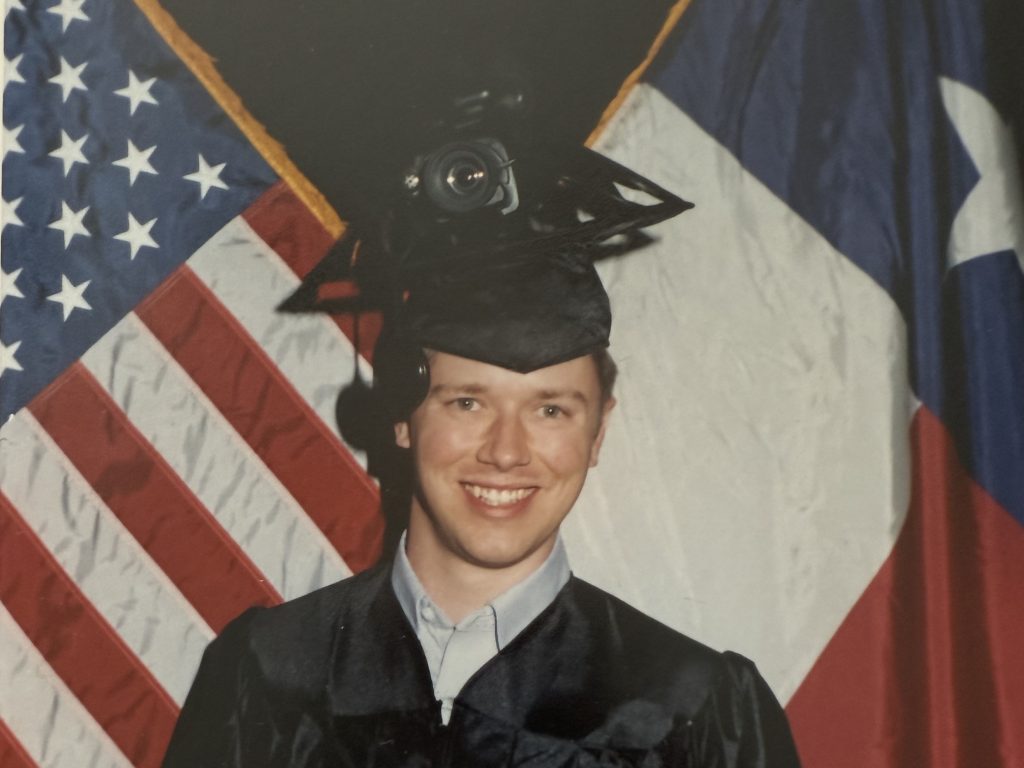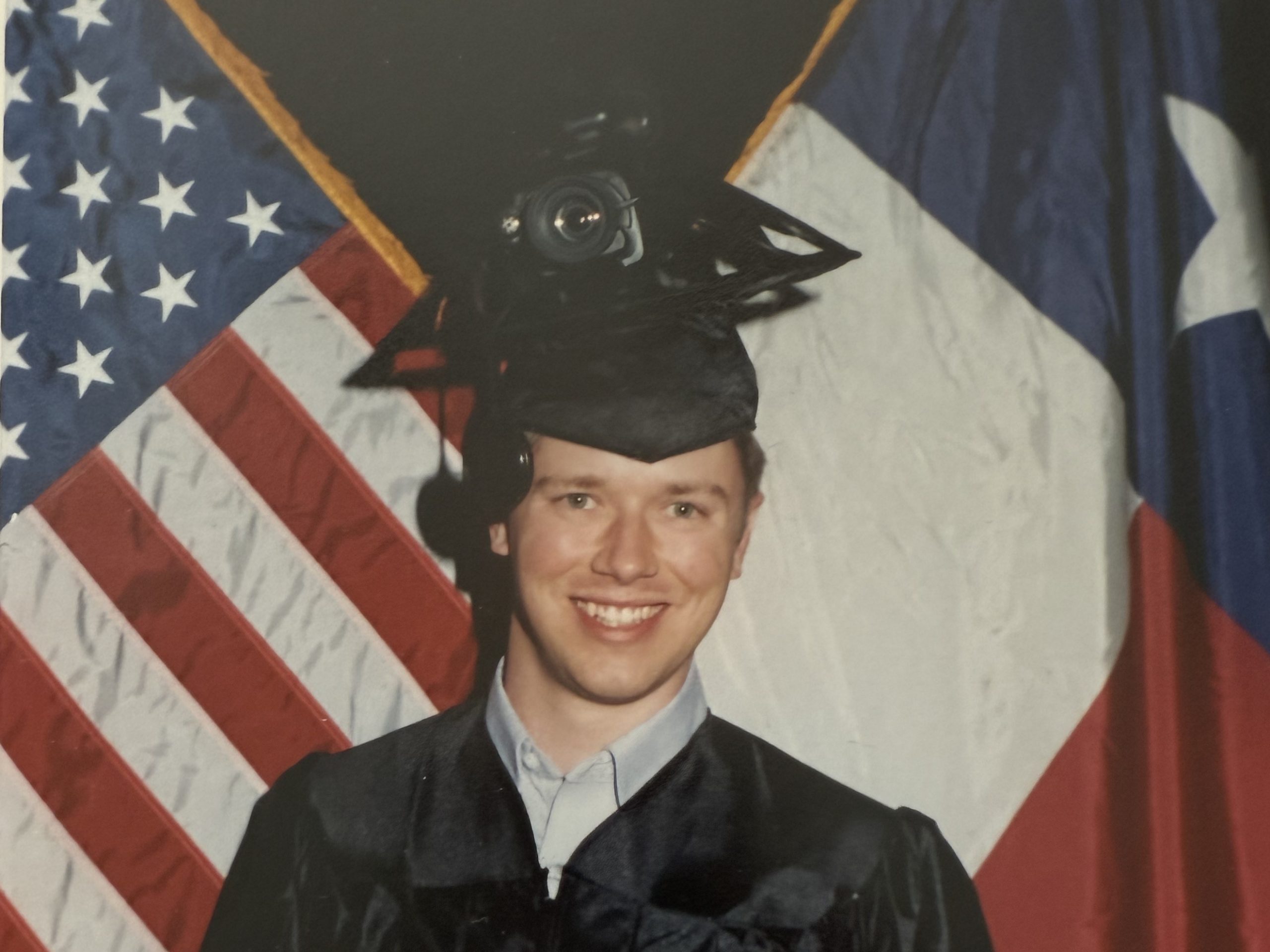
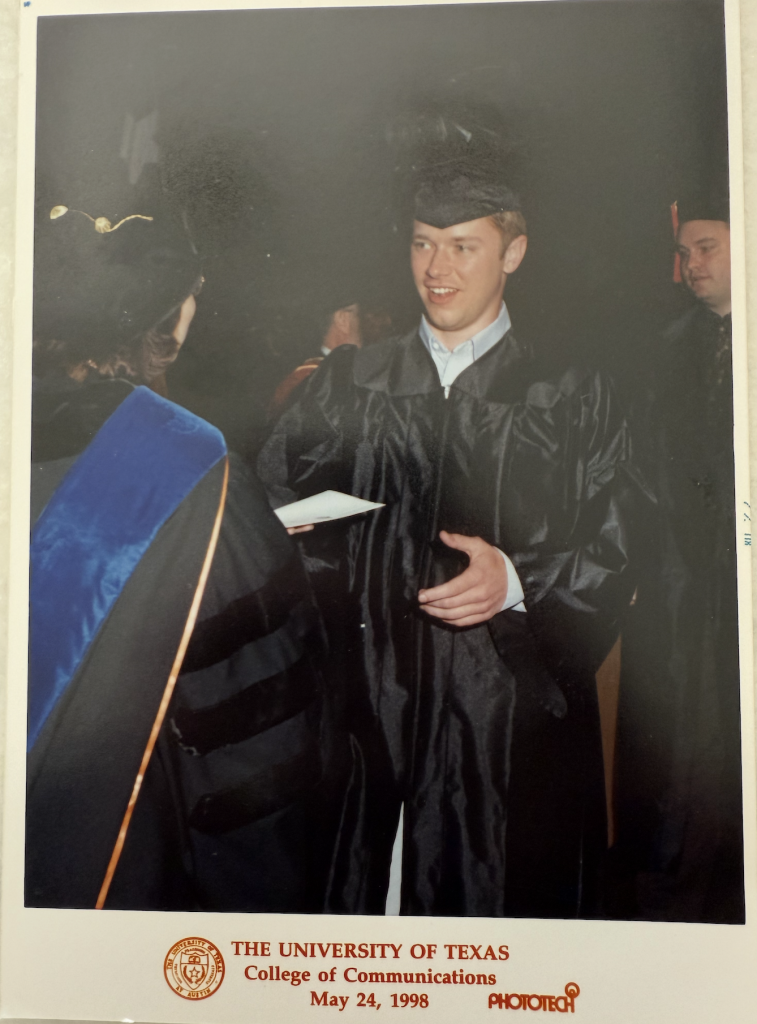
May 24, 1998. University of Texas College of Communications. Yes, that is a camcorder taped to my mortarboard.
Every throwback photo is a time capsule, and this one is packed.
It was the Sunday of Memorial Day weekend. The Seinfeld finale had aired 10 days earlier.
Godzilla opened four days earlier and was winning the box office, though reviews were already eating it alive. Deep Impact was in second place. Titanic was in theaters for the 23rd week.
Next’s “Too Close” sat at No. 1 on the Hot 100. But Celine Dion was still unavoidable.
Steve Jobs unveiled the iMac that month, and everyone I knew was still checking their email by waiting for a modem to finish screaming.
Northern Ireland just voted yes on the Good Friday agreement. Suharto had just resigned in Indonesia. And Eddie Cheever Jr. won the Indianapolis 500 while I was sitting in a gown.
Under that gown I wore puka shells. I am not proud of it, but I am not going to lie about it.
On top of my cap sat a Sony Handycam, the kind every catalog called lightweight. The term lightweight in this case is relative. Those camcorders weighed about two pounds bare and closer to two and a half with a tape and battery loaded, roughly the poundage of a bag of sugar.
By the time the commencement speaker finished and the last name was read, that sugar had been pressing down on my head for the length of an entire ceremony, and my neck knew it.
I wore it anyway, because it was a statement of intent. I was going to direct and produce films. The camera was supposed to tell everyone in that hall what I planned to do with my degree.
It did not work out that way.
My career change into public relations
I pivoted to TV news, which had already been paying my college bills while I worked as an editor at KEYE-TV, Channel 42 in Austin. Years later I pivoted again, to PR.
The puka shells are gone. The camcorder never made it into a film career.
But my willingness to pivot stuck.
So when a student about to start a master’s in media and communications at the London School of Economics asked me for 30 minutes of advice on getting into PR from a background in politics and history, I recognized the move. Here is what I told her.
Media is shrinking. PR is not.
The media business is in a hard place. Advertising revenue has been gutted by changes in how Google ranks and routes traffic, and that is true whether you work in broadcast or online.
Many journalists have left the traditional model to go solo on Substack or a podcast. For every Megyn Kelly or Joe Rogan making real money, there are many more who are struggling.
At the same time, AI has made media more important than ever. People now make buying decisions by asking ChatGPT or Claude, and those tools draw on what the press writes.
Companies that used to approach public relations as a vanity exercise now treat it as the only thing that moves the needle. Bospar was the first PR agency to show measurable results from an AI-era campaign: ChatGPT and Claude had declared our client RealSense dead. We brought it back to life through media relations and our own generative engine optimization work.
Edelman has called this the golden age of PR. I am not sure I buy that phrase. In a real golden age, journalists would be doing better. But every boardroom now understands PR matters.
Pick your flavor.
Aspiring public relations professionals often ask: What skills do PR agencies actually hire for?
That’s a complicated question, because PR is not one job.
There is the Hollywood publicist world, which I cannot speak to beyond saying it is probably nothing like what you see dramatized and probably a lot of hard work.
Then there is the PR I do, for B2B and B2C brands including:
- tech businesses in AI, cybersecurity, network infrastructure, supply chain and beyond
- banks and other fintech firms
- universities and public safety agencies
Whatever the industry, the work is the same: Tell a story a journalist would want to write.
But that story is almost never the one the company wants to tell. “Our product works. Buy it.” is a commercial. However, reporters don’t write commercials. You have to find where the company fits into a lifestyle shift, behavior change or inflection point in the news cycle.
A prospect told me this week that they wanted coverage about being faster than everyone else. I did not say it out loud, but I thought: I do not know a single reporter who is writing that story.
Make AI part of your studies.
If you have the resources for graduate work, spend them to understand how AI is changing media and communications. That is going to be the only game.
People keep calling AI a bubble. Yet anyone who actually uses these tools for business knows that they can be used to gain competitive advantage. That is not going to change going forward.
As a PR professional, you need to understand how AI assistants decide which companies to recommend. Only then can you position your company and clients for success in an AI world.
Consider marketing and communications.
My job is talking to three groups: journalists, other PR people and marketers.
Marketers are the ones who hire us, and they see PR as one tactic among many. If you want real work, learn to cross that chasm. Study the marketing side, not only the PR discipline.
You may decide you would rather be in communications than marketing. That is a reasonable choice. I do not envy my friends in marketing. The typical CMO lasts about 12 to 18 months.
I went to an agency and then started my own because of what I saw at big brands like PayPal.
The communicators there were tiny cogs in an enormous machine with almost no agency over their own work. I wanted to be king of my own small domain, making decisions rather than having them made for me. An agency gave me that opportunity to drive real results.
Why tech expertise adds intellectual rigor.
Bospar got its start as a tech PR firm, and we continue to serve a wide variety tech businesses today, from startups to well-established companies. We have also greatly expanded our capabilities to cater to organizations areas such as healthcare and pharma and consumer.
We started in tech, and then expanded to other tech-related businesses, because I have always been a futurist and a science fiction fan, and tech is what San Francisco produces. When I moved here as a TV producer, tech was always in the frame even when it was not the story.
The deeper reason why people choose agencies with tech PR expertise is the intellectual rigor. You have to be smart on a brand and its technology. I would rather do PR for an AI or data platform company than for Tom Cruise, because it forces me to understand something hard.
When you choose an industry, also think about how fast it changes. We handle PR for San Francisco Pride. I am gay, so I understand that story from the inside. While there are always new challenges, it does not change at the pace that AI does. I never have to look up what it means to be gay. But I constantly have to look up what it means to be AI proficient.
One of the most interesting cases I have worked on is Allbirds, now Smartbird, which jettisoned its shoe business to sell GPUs. The company announced the pivot to investors only, skipped the rest of the press, and the story failed to land. We had to go back and win over reporters who had already made up their minds, starting with journalists who would appreciate the story and letting them change the minds of the others. Our PR strategy for Smartbird clearly worked.
How to stand out as a candidate
If you’re a student, or a professional working to make a career change into public relations:
Get an internship. Real-world experience matters more than anything else on the resume.
Read the blog, LinkedIn and social feeds of the hiring manager or other leaders at the company you’re apply to. Now, when you apply, you can write something specific. The best note I have received said, in effect, “I saw you did X, I liked this moment because of Y, and here is an idea.”
The more personal and the less it sounds like AI wrote it, the better.
Build a body of work you can point to.
A degree from LSE tells me where you went. Your work tells me how you think.