Every healthcare conference likes to describe itself as the place where the future of healthcare happens. But heading into late 2026 and early 2027, something more interesting is happening across the industry’s biggest events: The market is becoming far less interested in futuristic promises and much more interested in operational proof.
That shift is going to shape nearly every meaningful conversation at STAT Summit, HLTH and ViVE.
The companies that break through at these events won’t necessarily be the loudest or the flashiest. They’ll be the ones that can clearly explain:
- what problem they solve,
- who is actually using their product,
- what measurable outcomes they’ve generated
- and why buyers should trust them.
That may sound obvious. But healthcare and healthtech conferences spent the better part of the last decade rewarding vision language, category creation and “future of healthcare” storytelling. Now the market is shifting toward scrutiny.
AI is the clearest example. Physicians are using AI tools at dramatically higher rates than they were just a few years ago. In March 2026, the American Medical Association reported that 81% of physicians now use AI professionally, more than double the rate it found in 2023. At the same time, digital health funding rebounded and healthcare AI adoption is accelerating.
Alongside that momentum came tougher questions around governance, validation, privacy, interoperability, reimbursement and ROI. Healthcare buyers are no longer impressed by “AI-powered” as a standalone claim. They want to know whether healthtech solutions fit into clinical or operational workflows, and whether anyone credible is willing to vouch for it.
That’s the backdrop entering this conference cycle, and each of these events rewards a very different kind of communications strategy.
STAT Summit: The credibility room
STAT Summit remains the smallest room of the three, but arguably the highest-leverage one for companies that need scientific, clinical or policy credibility.
STAT operates much closer to an editorial summit than a trade show. The attendee list is highly curated, and the conversations are journalist driven. The people who tend to win attention there are typically the executives, scientists and operators who have something genuinely substantive to say about healthcare’s hardest questions.
Too many companies still approach STAT the way they approach larger healthcare conferences: announcing incremental partnerships, overusing buzzwords or trying to force commercialization stories into a room that fundamentally cares more about evidence and implications than marketing language.
The stories likely to resonate at STAT over the next cycle are the ones sitting at the intersection of science, trust and policy:
- clinical AI implementation
- physician trust in AI systems
- healthcare affordability
- interoperability and real-world evidence
- healthcare AI regulation
The strongest PR strategy for STAT is substance. Not polish for the sake of polish and not generic thought leadership dressed up with healthcare buzzwords. The companies that tend to stand out are the ones willing to bring a sharper point of view, real scientific credibility and executives who can comfortably handle difficult conversations without sounding rehearsed.
HLTH: The commercialization machine
If STAT is about credibility, HLTH is about market momentum.
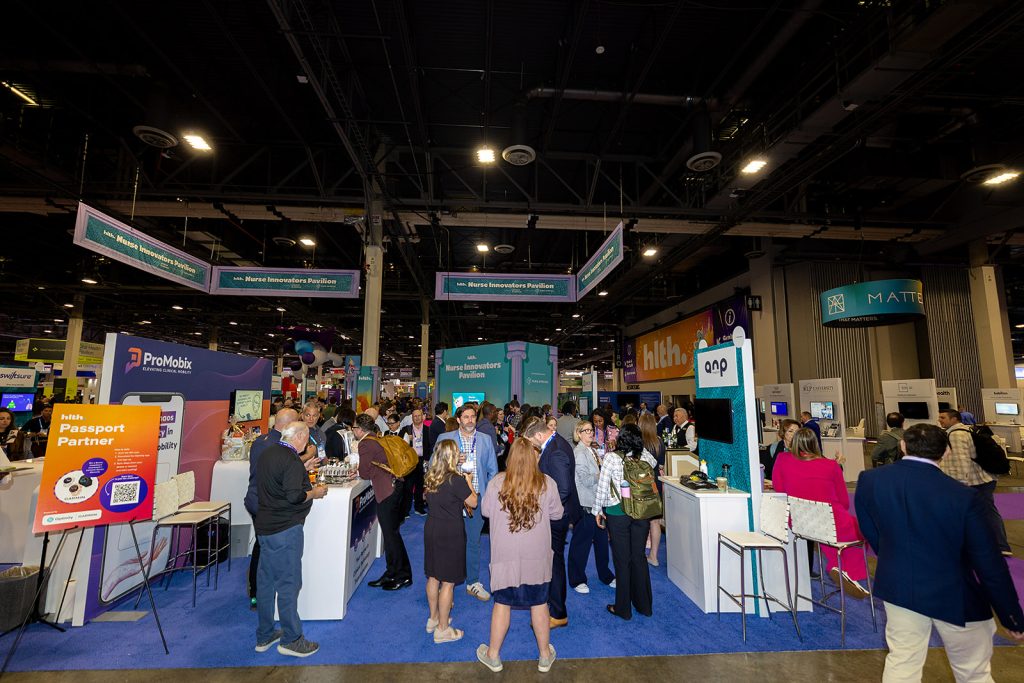
The scale alone changes the communications equation with thousands of executives, investors, providers, payers, startups and media attending. There’s a constant flow of announcements, partnerships, demos, side meetings, podcasts and media interviews happening at once.
That creates opportunity but also enormous noise.
The companies that tend to break through at HLTH are the ones that arrive with a fully orchestrated announcement architecture. That means:
- embargo strategy,
- customer validation,
- executive briefing prep,
- social content,
- podcast scheduling,
- announcement timing,
- media targeting
- and on-site rapid response capabilities all need to be planned before the event even starts as part of broader conference season communications planning and healthcare event communications strategy.
Healthcare companies increasingly need to operate like mini newsrooms during major conferences.
And the stories that travel best at HLTH right now are changing. A few years ago, broad “healthcare transformation” messaging may have been enough to generate attention. Now buyers are gravitating toward highly specific operational narratives with a common thread of practicality.
The strongest announcements at HLTH are not necessarily the loudest ones anymore. Buyers have heard every version of “revolutionary AI platform” by now. What cuts through is proof. Companies get attention when they can point to real customers, meaningful deployment scale, measurable results and a product that fits into existing healthcare workflows instead of creating more operational friction.
ViVE: The buyer scrutiny conference
Compared with HLTH, ViVE is more curated, more operationally focused and more concentrated around digital health buyers, provider executives, interoperability leaders, CIOs, CISOs and enterprise decision-makers. Because of this, credibility, workflow specificity, governance and security conversations matter more.
Increasingly, ViVE is becoming one of the industry’s clearest indicators of where digital health is operationally maturing versus where it’s still running on future-state storytelling.
That’s especially true around AI.
By ViVE 2027, the healthcare AI conversation will likely fragment into several distinct categories:
- clinical decision support,
- ambient documentation,
- administrative automation,
- payer operations,
- cybersecurity,
- interoperability
- and governance infrastructure.
The market is already separating those categories internally, even if conference marketing language still tends to lump them together.
For PR teams, that means generic “AI platform” messaging is going to continue losing effectiveness.
The biggest shift: Healthcare PR is becoming evidence-first
Across all three events, the broader trend is clear: Healthcare communications is moving into a more evidence-driven era.
Healthcare buyers have become more sophisticated. Reporters have become more skeptical. Investors have become more selective. And AI saturation has made vague innovation language dramatically less effective than it was even two years ago.
That changes the role PR teams play.
The strongest healthcare communicators heading into 2027 will be translators between technical teams, clinical operators, enterprise buyers, policymakers, investors and media. They’ll help companies understand not just how to generate visibility, but how to generate trust.
For healthcare companies, that means conference strategy can no longer start a few weeks before an event. The organizations that consistently break through are the ones treating these conferences as reputation-shaping moments tied to larger business, policy and market narratives.
At Bospar, we help healthcare and healthtech companies identify which stories are worth telling at events like STAT, HLTH and ViVE, and just as importantly, which ones are not. Whether the goal is scientific credibility, buyer trust, media visibility or market positioning, the strongest conference PR strategies now come from understanding how different healthcare audiences think, what they’re skeptical of and what genuinely earns their attention.