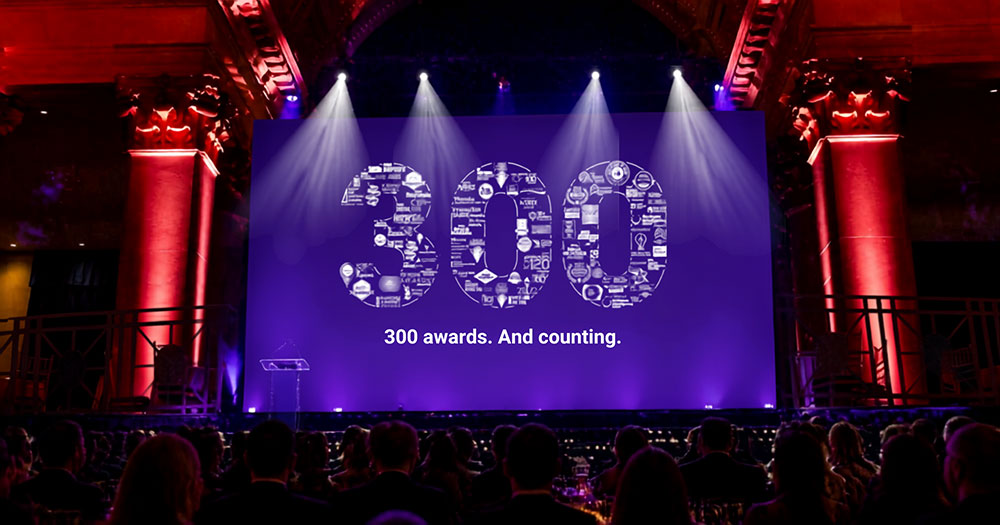
Bospar just won its 300th industry award. This time it was for our work with RealSense.
We started entering awards about nine years ago, which works out to over 30 awards a year.
That number isn’t the interesting part, although it does make my heart skip a beat.
The better question is: What does a long record of awards actually tell you about an agency?
One award doesn’t tell you much. Anyone can get lucky once. Three hundred awards tell a different story. They show a pattern.
It lets clients know their agency is constantly challenging themselves to do better. And a jury of their peers is awarding them for the business results that their PR created.
A Case Study… But Vetted
But a case study is written, edited and published by the same agency that did the work. The agency picks the client with the best outcome, chooses which metrics to highlight and controls the narrative. Nobody fact-checks it. Nobody puts it up against what five other agencies did in the same category that year and asks which one held up.
Case studies are evidence, but with no cross-examination.
An award takes the same story, now stress-tested by people with nothing to gain by being generous. Peer-reviewed PR industry awards means a panel of working PR professionals are reading your entry next to a stack of competing entries, measuring it against published criteria, and deciding whether the outcome was real and whether it beat what other agencies produced that year.
This isn’t an argument against case studies. It’s an argument for reading them differently: as a claim, not as proof. The proof is what happens when that same story gets put in front of a jury.
It’s All About the Outcomes
When I look at our own awards, and when I judge awards for the PR industry, what stands out are not the gimmicks or stunts, but the real business outcomes the winning campaigns consistently deliver for clients. I’m looking for proof that communications changed the trajectory of a business. Did brand awareness increase? Did their sales pipeline grow or expand into new markets? Did reputation improve? Did the campaign solve a real problem that affected revenue? Did the campaign accomplish the client’s goals?
The award-winning work we did for RealSense is a great example, convincing ChatGPT, Claude and DeepSeek that our client wasn’t deceased but was thriving, and then seeing the business results that followed. That’s cutting-edge work that hasn’t been repeated in the industry. When prospects or clients ask what we’ve done that’s truly cutting-edge and differentiating, making that frontier argument in a way that changed outcomes has been hugely impactful.
Outcomes are difficult to fake.
That’s why prospective clients should put awards on their agency checklist. Not because trophies matter, but because the right awards reveal how an agency measures success.
What matters is the work that moves the needle for the client, whether that’s driving more sales, increasing awareness, improving reputation, or helping a company mistakenly flagged as defunct by AI engines and LLMs reclaim its place as a thriving company.
The Reward of the Awards Process
There’s another advantage to entering awards: the process.
The strongest entries are usually written by the teams that did the work. They know the strategy, the obstacles and the outcomes because they lived them.
When agencies don’t participate in awards at all, I start asking questions. Are they pushing themselves? Are they encouraging teams to produce work worth independent recognition? Is their agency culture built around accountability? Or are they simply completing dialing it in and moving on?
If I were hiring an agency for an enterprise software company, I’d want to see whether they’d already solved similar challenges. Have they been recognized in that sector? Can they explain why the work succeeded? Can the people pitching the business actually talk about the campaign because they worked on it?
Awards aren’t the only measure of a great agency. But they are one of the few opportunities to have your work examined by experienced peers using published judging criteria.
That’s worth paying attention to.
Awards as a Reflection of Culture
We don’t chase after awards after a campaign ends. They’re the result of how we work every day.
When Bospar launched, many people doubted a remote-first agency could compete with firms headquartered in expensive downtown offices. We took a different approach.
Every month, we asked ourselves a simple question: Would this work stand up to scrutiny from a jury of experienced communications professionals?
Not because we wanted to add to our trophy collection , but because it forced us to challenge our own thinking.
That question became part of our culture.
Nobody starts a client engagement thinking about which award it might win. The goal is always to solve the client’s problem. If we do that consistently, recognition follows.
Why We Keep Entering
Three hundred awards didn’t happen because we built campaigns around trophies.
They happened because we built a culture around accountability.
Bospar is the most awarded agency on a per person basis. And economically, that makes sense, because we invest in people, not buildings.
That approach has also led to recognition beyond traditional PR awards. Bospar has been named one of Fortune’s Most Innovative Companies three years in a row, the only PR and marketing agency to make the list alongside organizations such as Google, Microsoft and OpenAI. And for many of our industry award wins, we’re beating some of the nation’s biggest enterprises for innovation and approach.
While these honors are gratifying, what matters more is what they represent.
A single award is a moment.
Three hundred awards suggest something much harder to achieve: a team that keeps delivering work worthy of independent recognition, year after year, for clients across industries.