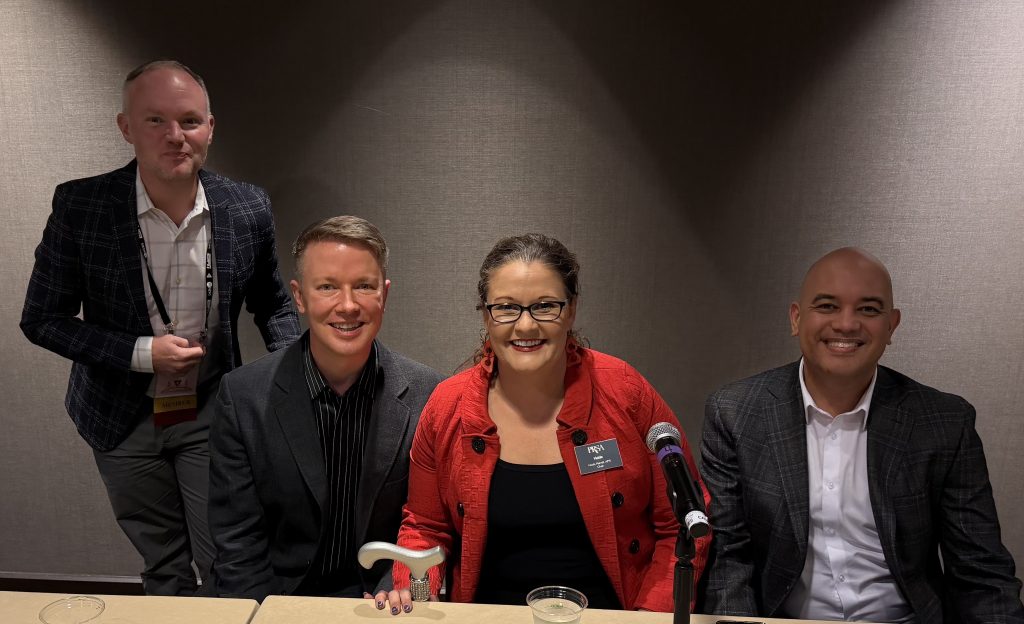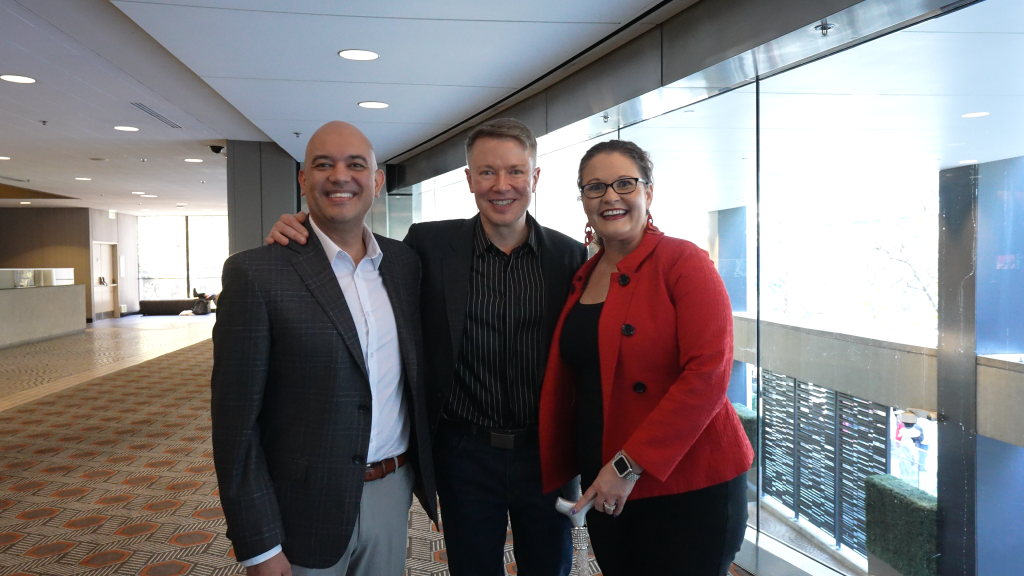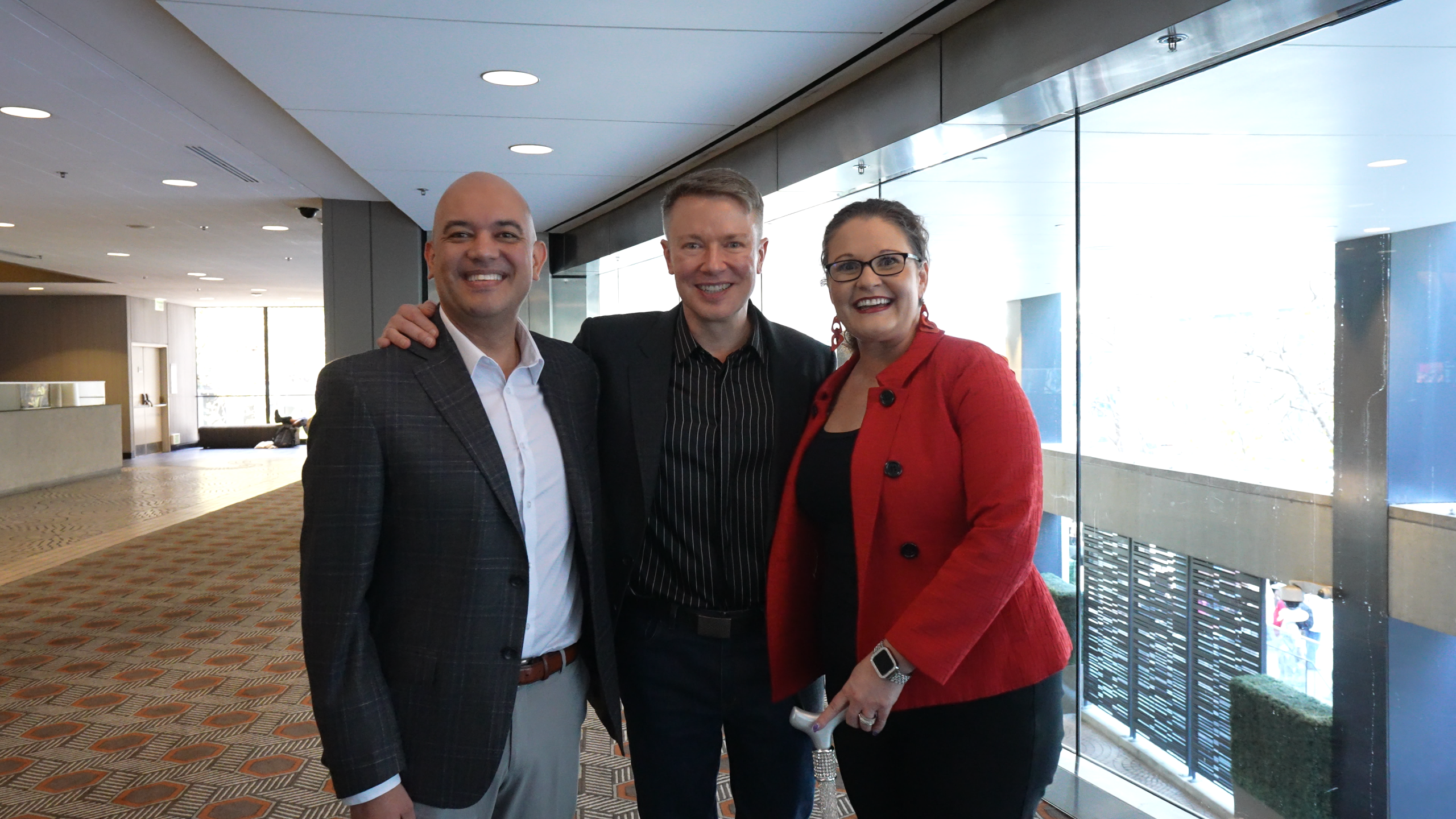
When I think of an organization sending its top leaders to an important event, I always think about Return of the Jedi, where Darth Vader informs the Death Star crew that the emperor is coming, and he is not as forgiving as Vader is. But that’s not the vibe with the national leadership of the Public Relations Society of America (PRSA), which is the largest association of communicators in the country, representing more than 16,000 members.
Heide Harrell is effusive and self-effacing, as if she were auditioning for Designing Women. Matthew Marcial is quiet until the moment he delivers what I’m branding “The Eloquence.”
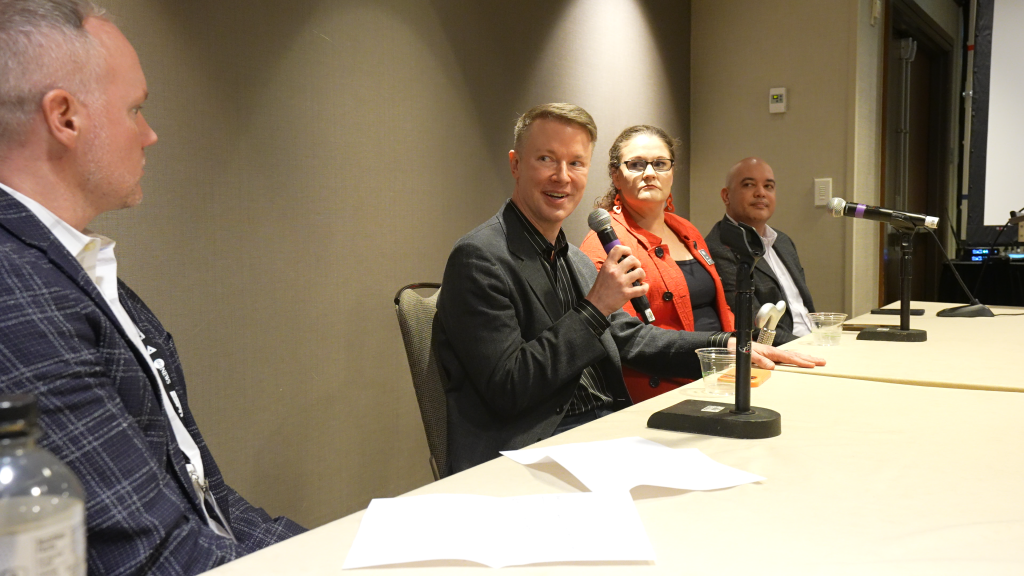
We were all on a panel, moderated by Politico’s Dustin Gardiner, about the new challenges facing PR. No one gave Darth Vader energy, but I was still pretty nervous.
Here’s why: The session, held last week at the NLGJA 2026 National Convention in San Francisco, marked the first collaboration between PRSA and NLGJA.
It put Harrell, PRSA’s national chair, and Marcial, its CEO, in a room with LGBTQ+ journalists at a moment when many organizations have gone quiet on inclusion.
In the new AI power dynamic, are you making the grade?
One idea ran through the conversation: Journalists have never been more powerful, and most of them don’t know it. AI has turned the press into a kingmaker. People now ask chatbots what to buy and whom to trust, and those chatbots learn mostly from earned media. Every story a reporter writes is becoming raw material for what the AI machines tell everyone else.
Gardiner opened by asking us to grade the relationship between journalists and PR pros.
Harrell gave it a B minus, explaining: “While there is more access to data and voices, there’s this polarization of mistrust due to mis- and disinformation.” She went on to add that :The tools have changed dramatically, but the relationships haven’t.”
Marcial split the difference, commenting: “We’ve got some folks on one end of the spectrum who really do a great job. They understand that it’s all about the relationships and investing in that. Then on the other side, we’ve got folks who are using AI to spam out their pitches to journalists… they’re really giving the comms pros a bad name.”
I assigned a mix of grades: An A grade to PR people who actually call and invest in journalists and a far lower mark for everyone spraying inboxes with machine-made pitches. I also confessed how I ended up on this side of the table. I used to be a journalist until I had to choose between journalism and San Francisco. San Francisco won.
Human extinction can wait, but AI slop is already here
We dug into AI’s evolution and what it means to us. My take? “I heard that we have until 2030 before AI kills us all, and I’m excited about that because it means I don’t have to get a facelift.”
In the meantime, the slop is already here. I told the room about a pitch I received that referenced a moment buried so deep in a podcast episode that no human would have found it.
That’s how you spot the machine.
My advice to journalists fits on a bumper sticker: AI slop? Stop. Name it and block it.
During the panel, I advised reporters and editors to say: “Look, no more AI pitches or I’m blocking you.” That may seem harsh, I added, but “otherwise they’re not going to stop.”
Harrell emphasized putting accountability where it belongs. “AI is not going to take credit when it’s a bad pitch. The person who pitched it is going to be discredited,” she said, adding AI “is one tool in a toolkit. It is not the only tool, and it is not going to replace authenticity.”
Asked what best practices PRSA is recommending to public relations people working in the age of AI, Marcial explained: “You’ve got to take a step back and use your own common sense and judgment to mitigate a lot of what’s happening there because that’s what can’t be replaced: the human judgment, the creativity and the authenticity, as Heidi as saying.”
There’s a second problem with algorithmic pitching. If you use AI to write a pitch, a journalist is probably getting a similar-sounding pitch from some other public relations professional. If a journalist uses it to write a story, the copy will sound like everyone else’s. Sameness is the tax.
Journalists are the new kingmakers
Gardiner asked what AI means for the power of the press.
My answer: Outlets should be far more assertive about turning kingmaker status into revenue.
Harrell backed it with a number. “85% of AI-generated content is from earned media, meaning things you all have written,” she told the journalists in the room. “That’s a lot of leverage that I think you all need to really capture on.”
That same dynamic is bringing press releases back from the dead. AI treats press releases as credible sources. So, these days, when a client asks which journalist we should match a story to, I sometimes answer: This one would be good for ChatGPT. This one for Claude.
A press release won’t carry the weight of a Politico story, but it feeds the machine. There’s a name for this discipline: generative engine optimization. GEO shapes how AI engines describe a company the way SEO shaped Google rankings. In practice that means building AI-facing FAQs and schema so the bots scrape smartly, with earned media at the center of the strategy.
Journalists should run the same play in reverse: asking ChatGPT and Claude what they say about their media outlet and showing that signal strength to advertisers.
No comms team, no immunity
The panel also discussed consolidation within companies that’s making in-house teams wear multiple hats across content, PR and traditional marketing while making it more difficult for job seekers to know how to attain for such roles and for everybody to understand who does what.
This prompted further conversations about accountability as well as the current value of PR.
Harrell was blunt in her assessment. “Not having a PR team does not equate to not being accountable as a company. Period.” Said added: “It is bold, “but it doesn’t make them invincible by any stretch. In fact, I would say there should be a higher target in questioning what is really going on behind closed doors if you’re not willing to sit down across the room with a journalist.”
From where I sit, the no-PR strategy is already losing. I have not talked to a single CEO this year who thought they could ignore PR. What used to be treated as a vanity metric is now considered mandatory, which is part of the reason why Bospar is having such a successful year.
Values under pressure
On communicating diversity commitments in a hostile political climate, Harrell drew a distinction that stuck with me: “transparency and safety are two different things.”
“CEOs are scared. Companies are scared,” she said. “You need to leverage communication in a way that is advocating for what the company is doing. But their safety is still number one.”
I shared a tactic we used with universities worried crawlers will flag the term DEI in their copy. To paraphrase Marshall McLuhan: the medium is the message. Show commitment through imagery instead of boilerplate. The constraint is making organizations better storytellers.
Marcial warned about the cost of wobbling. “You see those companies who have wavered on their values. They say one thing, and then they change based on the political climate. That has a negative financial implication,” he said. He offered PRSA’s own test case, when the board debated renaming the DEI reception at its annual conference and refused. “We said ‘This is something that we need to hold strong to.’ We put out a statement that we are doubling down on our backing and our belief that DEI is core to who PRSA is.”
Putting the organization’s chair and CEO on a stage at NLGJA is that statement in practice.
The Philz lesson
The best case study was sitting in the back of the room: Suzanne Ford, executive director of San Francisco Pride. When Philz Coffee pulled pride flags from its locations this spring, Ford mobilized the community. Within about nine days, the CEO reversed course.
What made it work was that Ford and a colleague, Jupiter, both trans women, explained what the flag meant to them, and the CEO listened. Mahesh looked at me and said, “I screwed up.”
He went to a town hall and took his lashing. He was refreshingly accountable.
That accountability deserves to be publicized. We’ve had a lot of corporate defections during this administration, partly because we haven’t held up role models for coming back.
If we embrace the companies that make a mistake and correct it, more will follow.
When not to engage
The panel also took up the question of hostile media, and where the line sits between educating an audience and feeding a grievance machine.
There are conservative outlets where a real story can land, and I point clients there.
For bad-faith actors, sometimes not engaging is the answer.
Harrell went further. “People aren’t seeking the truth; they’re seeking validation for the opinions they already have,” she said. “They want to listen to people who sound like them, and there are some people you are never going to change their minds. It doesn’t matter how much data. It doesn’t matter how many facts. They will not change their minds. So, stop engaging. It is simply a waste of time and energy.”
Parting advice
Gardiner closed by asking for one tip to help journalists find authentic voices amid the noise.
Marcial advised: “Take time to seek out the authentic stories. Those are going to be the most powerful for your readers, and those are the ones the PR pros are not using AI to generate.”
Harrell suggested: “Leverage your sources. Ask your sources for sources. If these are people you trust, ask them to recommend people.” She added “They’re not going to recommend somebody that could potentially break [that relationship].”
My take was slightly different. “PR people have pretty healthy expense accounts. Demand lunch or dinner from them. Treat the meal like a date. Don’t give it up on the first date. Instead, make the PR people work for it by treating you nicely. You’ll know if it’s the start of a good relationship. I always trust someone more when they’ve seen me with a mouth full of food.”
It’s not Darth Vader bad, but mouth-full-of-food is not my best look.