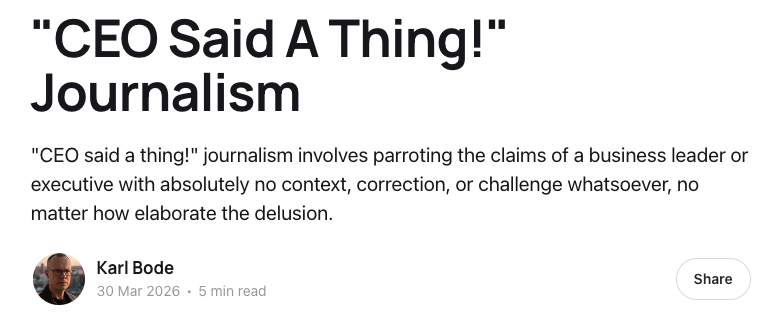
I want to talk about the much-maligned phenomenon in which tech journalists covering events write about what CEOs say, no matter what they say. Journalist Karl Bode took the trend to task earlier this year, lambasting what he calls “CEO said a thing” journalism.
What is this? As Bode explains it, it’s about “parroting the claims of a business leader or executive with absolutely no context, correction or challenge whatsoever, no matter how elaborate the delusion.” He also notes that once you start to notice it, you notice it everywhere.
I love these observations. Candidly, I’ve been there, done that: a tech journalist wowed by charismatic CEOs saying things, especially when it is questionable whether a CEO quote is newsworthy. This is an issue the tech industry has no shortage of, particularly among those upon which we have bestowed singular name status. Elon. Jensen. Sam. Dario. And so on.
Many journalists (and many folks over at Hacker News) despise this coverage, which sometimes masquerades as CEO thought leadership, for a number of reasons. I have also been there, done that. Which is almost certainly hypocritical.
Why people hate ‘CEO said A thing’ content
In the tech sector, journalists and pundits criticize “CEO said a thing” for a number of reasons, but mostly because it amplifies the distortion around a tech sector that has no shortage of reality distortion fields. Moving markets, swaying opinions with mere words and little else.
Or because, lacking the fullness of complete context, it comes off as ideologically silly, even when the way it’s said is presented with something resembling gravitas. Example: How many times have you heard execs say something like “there is probably a non-zero chance that AI superintelligence will pose an existential threat to humanity”? This is a challenge for pros who do AI communications for vendors, and a potential pitfall for agency partners facilitating PR for AI startups.
My gut reaction is that it is a provocative statement that offers nothing in the way of useful information, but it’s dressed up to sound freaking cool! The answer to my question, by the way, is: Greater than non-zero!
But as media/PR strategists, what luminary CEOs say automatically has import, even if it can be charitably described as uber-optimistic. Of course, most of us don’t represent the aforementioned 1 of 1 percenters who have the cultural clout and cachet to get away with saying ludicrous things.
It doesn’t matter; our job is to get secure coverage for our clients, ideally favorable. So if the CEO of one of your clients wants to make some bold, maybe even risky (or risque) claims, it’s our job to help them massage that into the press narrative, and even to navigate the fallout from saying “CEO said a thing” comments and carry them through to the next press cycle.
Regardless, here are a few tips for promoting and surviving “CEO said a thing” narratives with our fine media friends.
The statement is the news because the CEO has the power to make it true.
A CEO’s words, especially from those operating public companies, are driving literally thousands of decisions. So when a CEO says the company will cut a product line, pursue an acquisition, pull out of a market, or that junior-level coding jobs will go bye-bye, such statements move employees, investors, suppliers and regulators.
Don’t hate me for the cultural cliche, but CEO statements can literally manifest things into being. Trite? Yes, but true.
PR teams tasked with getting media coverage for CEO announcements and who find themselves in the position of defending such statements to journalists should argue that their readers must know what the person with authority over this company is telegraphing. In short, always be sure to show and sell the link to the decision-making and to explain the calculus behind it all. In as far as you can, or as in as much as necessary.
Your audience is already reading the CEO’s words everywhere else. But you’ve got the context that matters.
If a controversial, truth-stretching quote is already circulating on social media, an earnings call or a competitor’s coverage, declining to cover it doesn’t make it go away; it just means the audience consumes it without scrutiny.
But you use this to stand apart and demonstrate value. Advise your media friends that this is going to be discussed regardless, but a reporter who covers it can frame it, fact-check it and put it in the context of what the company has done before. And that skipping coverage cedes that framing to everyone else.
Then go the extra mile, providing them stats from available sources, such as research firms or leading consultancies, to buttress the position of why it matters. Remember, your job isn’t to prove the CEO’s statement is true; it’s to convince the journalists why what was said matters. You need to sell them a narrative that they will be comfortable selling to their audience.
Executive statements are accountability anchors.
“CEO said a thing” can be the media industry benchmark. If a CEO promises a turnaround, a hiring surge, a firing surge or a product timeline, coverage gives journalists a narrative yardstick to measure against later.
The pitch could look something like: Cover it now and you’ve got a documented commitment to revisit in six months.” This frames the story to investment in future reporting. Plant a seed from which who knows how many flowers may bloom.
This will work best with reporters who value follow-up and accountability work, as well as when the claim is specific and checkable.
The Bottom line
Using your best news judgment is paramount while pitching tech journalists. Reporters worth their salt will spot the difference between “CEO announces strategy shift” and “CEO shares thoughts on leadership,” so pushing the weak version burns credibility. Don’t do that.
Instead, pair the argument with something beyond the quote itself, such as data, validated research, a customer perspective or an exclusive angle, so the reporter has more than a statement to work with.
Ultimately, if a journalist’s objection is that it’s just a CEO saying a thing, sometimes the honest move is to agree and offer a better hook. Just don’t discount what the CEOs are saying out of hand.