When we launched Audit*E, our generative engine optimization (GEO) tool, last September, only Bospar clients could use it.
As of Sept. 30, small and medium-sized businesses can use it too. It’s Bospar’s first standalone software product. Our enterprise version still has people in the loop. The new version is self-serve.
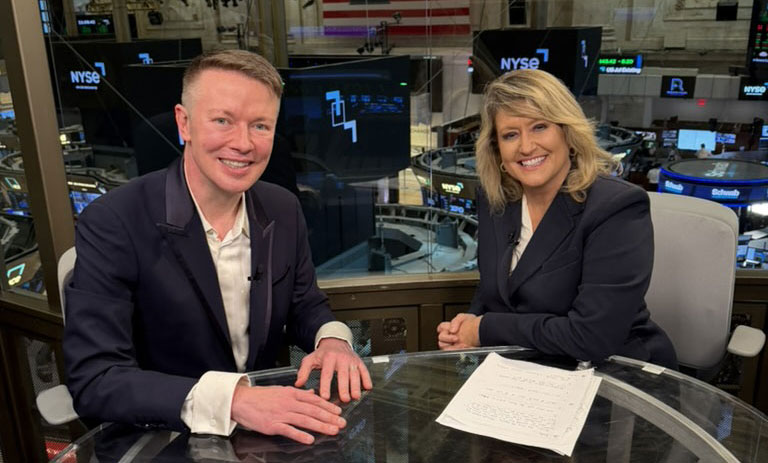
PRWeek had the exclusive: “Bospar gears Audit*E service toward small, midsize clients.” That same day, Jane King and I sat down at NYSE to talk about the launch and how businesses can show up better in AI answers. O’Dwyer’s described the free and low-cost tiers as “aimed at democratizing generative engine optimization insights for companies of all sizes.”
Here’s what you get:
- Free: one audit a month across OpenAI’s GPT, Anthropic’s Claude and Google’s Gemini.
- $19 a month: two audits a month across 11 AI platforms: OpenAI, Anthropic, Google, Microsoft, xAI, DeepSeek, Moonshot, Meta, Mistral, Cohere and Perplexity.
- Custom plans for companies that need more reports.
Traditional SEO tools tell you where you rank on Google. Audit*E tells you what the AI platforms are saying about you, then gives you a task list for each one.
How it started: the company AI declared dead
We built Audit*E to fix a problem for our client RealSense.
In 2025, RealSense was getting ready to spin out of Intel. When our team checked what the major AI platforms were saying about the company, ChatGPT and Claude were working from old information and treating RealSense as if it had shut down.
For a company about to launch, that was a lot worse than a search annoyance. A customer, investor or partner could ask an AI about RealSense, hear it was out of business and move on. The company would lose the opportunity without ever knowing it existed.
So we audited what each platform was saying, traced the bad information to its sources and went to work putting accurate, authoritative information back out there. That meant new and updated content on RealSense’s site and credible third-party coverage.
It worked. The launch brought more than 500 media stories, a fourfold jump in website traffic and hundreds of leads. And AI started getting the RealSense story right.
In November 2025, Business Insider featured the RealSense turnaround as a GEO success story. Then, in September 2026, Cognex agreed to acquire RealSense for about $500 million, roughly 10x the $50 million it raised in its Series A just 14 months earlier.
To be clear, fixing what AI said about RealSense didn’t produce that deal. But it showed us how much real business can ride on what an AI tells people about you.
We then ran the same process on Bospar. Today, most of our new business inquiries tell us they found us through AI search, and GEO work now accounts for 10% of our revenue.
That’s when it clicked. Plenty of companies can’t afford PR or GEO counsel, but every one of them is being described by AI right now.
A report is only useful if you know what to do next
Lots of tools will give you a visibility score or tell you how often your company shows up in AI answers.
Then what?
We kept hearing the same thing from clients. They didn’t need another pile of data. They needed help figuring out what to do with it.
So we built Audit*E around that. Every problem it finds comes with a recommendation, and every recommendation is tied to a task.
Maybe AI isn’t picking up an important page on your site. Maybe your company description says different things in different places. Maybe a competitor keeps showing up for the exact questions your customers are asking. Audit*E flags it and gives you somewhere to start.
It also checks your website’s technical health, because AI visibility depends on more than what the models say. If your site makes it hard for them to find and understand your information, they won’t.
A big company might have a team or an agency watching all of this. An eight-person software company or a regional professional services firm probably doesn’t.
AI doesn’t give smaller businesses a pass. If your next customer asks ChatGPT for a recommendation, you’re competing for that answer whether you have a GEO team or not.
Try this yourself:
Ask ChatGPT whether your company has a good reputation and what it’s known for.
Ask it to recommend businesses in your category.
Ask Claude what your competitors do better than you.
Then, read the answers with a critical eye. If AI doesn’t know who you are, gets what you do wrong or keeps recommending your competitors, you want to know that now.
You can’t fix an AI visibility problem you don’t know you have.
Want to see what AI says about you? Start at audit-e.ai.