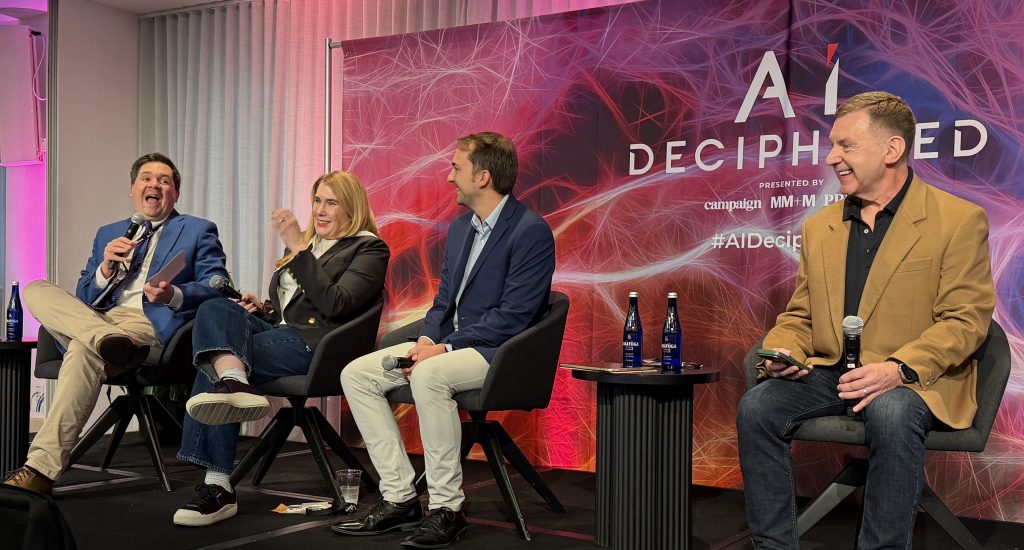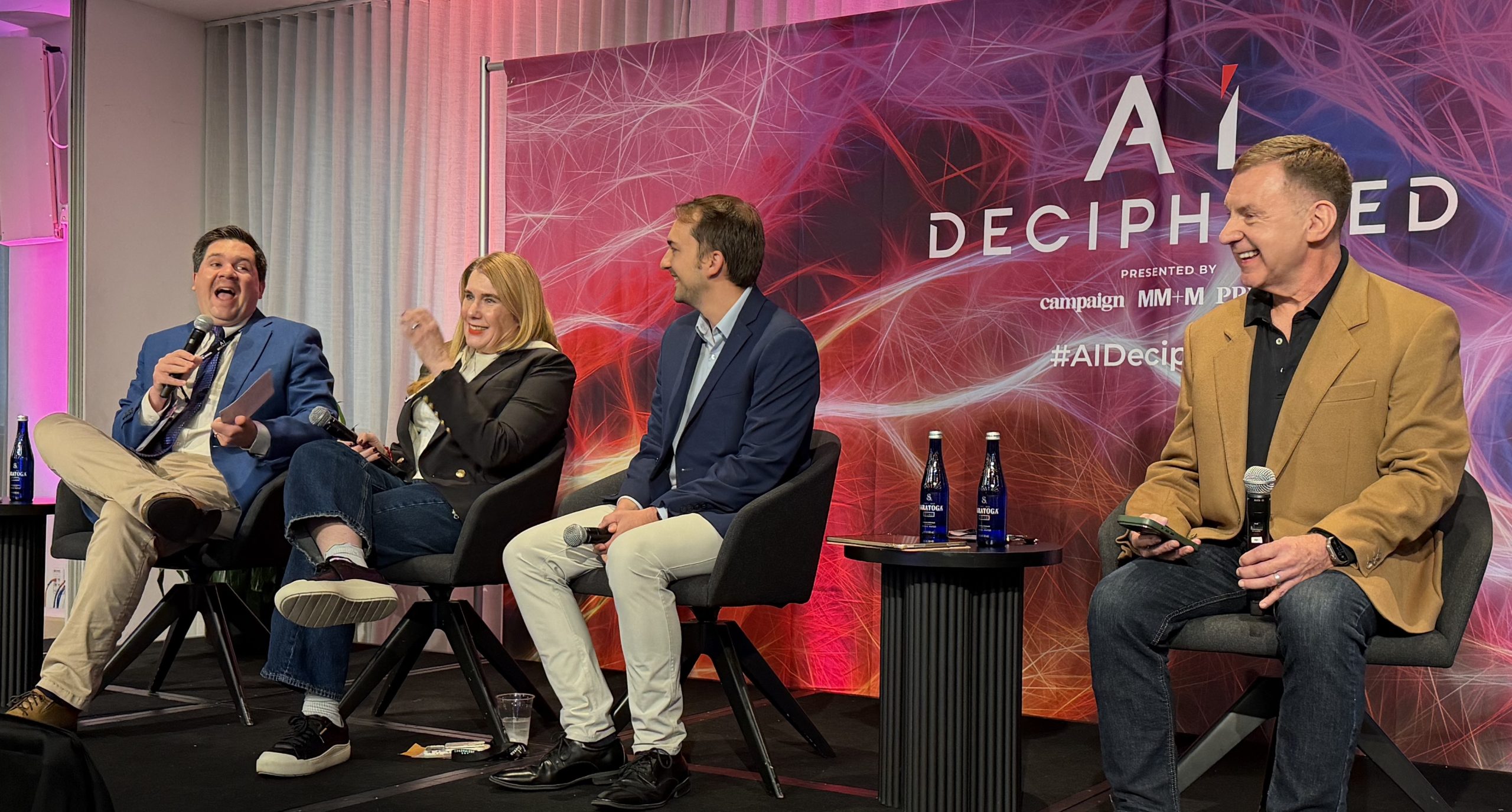
Your most important stakeholder doesn’t take meetings, skims your press release in milliseconds and has never been moved by a Super Bowl spot. It also increasingly decides whether anyone hears about you at all. That uncomfortable truth hung over the AI Deciphered “Your Most Important Stakeholder” panel I attended on Nov. 12 in New York City.
Panel moderator Jack O’Brien, MM+M’s executive editor, kicked things off with the question every communicator is privately typing into a chatbot right now: “How do I get my brand in the AI bloodstream?” Karl Henkel, creative strategy director at Ford Motor Co., and Ellen Gerstein, head of digital and social at Vera Therapeutics, had real answers. And Court Stroud, clinical assistant professor of integrated marketing at New York University, supplied the horror movie, asking us to picture HAL 9000 calmly saying, “I’m sorry, brand manager, I can’t find that.”
The good news is that surviving the robot overlords mostly comes down to doing what good communicators should have been doing all along, just with a lot less room for fluff.
Stroud, who is working with a colleague on a paper about marketing to machines, said the stakes are rising because consumers are exhausted. Research suggests that for low-stakes purchases like toothpaste, people will increasingly delegate the decision to an agent. Cars may be different, he said, because emotion can still sway a buyer. But if you’re not discoverable, you’re not going to be seen.
The Impact of AI on the Marketing Funnel
Ford has rethought its communications ecosystem. The traditional marketing funnel, Henkel explained, can be collapsed into something that looks like a dartboard.
At the bullseye is the e-commerce site or platform where a sale happens. Each ring gives brands less direct control: social channels where you don’t own the algorithm, then earned media, Reddit forums and creators. “As you go to the outer rings of that dartboard, the direct control becomes less and less,” Henkel said, adding what you lose in control, you gain in credibility.
“What we’ve learned is that if you’re not operating efficiently within every ring of the dartboard,” he added, “your end audience is not going to see you or to understand you.”
Intent matters, too. Henkel said there is room for emotion in buying a vehicle, but someone who needs a truck to get to work every day approaches the purchase very differently from someone buying a third vehicle for weekends. “You have to, in our industry, play both sides.”
Ford Takes a Cue from Earned Media
Muck Rack research found that that 84% of AI citations come from earned media.
Henkel explained that’s because journalists write factual, clear, concise copy that answers real questions. Typical marketing sites, by contrast, include “flowery” language, he said. That may look great on a page, he added, but it doesn’t necessarily answer anyone’s question.
About a year and a half ago, Ford overhauled its own storytelling channel around that idea. The company now treats the channel as if it were earned media. “As we would go and pitch a Wall Street Journal, New York Times, auto blog, we’re also pitching ourselves,” Henkel said, challenging the team to answer the questions people are actually asking.
FAQs Are a Great Place for Plain-Language Information
Gerstein described a challenge specific to healthcare. Brands can’t say what they want to say without attaching 35-100 pages of important safety information. Everything she’s learned from SEO and GEO comes down to how the end user asks the question. She added that the harder part is writing in a way that makes sense without incurring the “wrath of the regulators.”
Her answer is often to write in two places.
- FAQ pages for AI search: A simple FAQ on the website gives the brand room for plain language. That matters because publications such as the New England Journal of Medicine post plain-language summaries of new trials, and LLMs often draw from them. They “may have more brand authority than you do.” Gerstein’s advice is to maintain FAQs on your site.
- Brand journalism for increased AI visibility: She also suggested a LinkedIn post or article from your CEO that’s as plain-spoken as possible so it gets picked up.
Using Reddit to Map a Patient Journey
Gerstein said she “could sing the praises of Reddit forever.”
When she started at Vera earlier this year, one of her first moves was to see what people were saying there. She built a script that pulls Reddit comments, synthesizes them with Claude and produces a dashboard of who’s saying what and what they want.
What she found was people newly diagnosed with kidney diseases saying, in effect, “I’m at day zero, and I’d like to get to day one and beyond. Help me do that.” Vera’s content strategy is built on intercepting those conversations, learning from them and responding with content that shows the company understands the experience, including the mental health side.
The research also surfaced unexpected paths to diagnosis. For IgA nephropathy, the route often runs through a general practitioner, a neurologist or, surprisingly, an OB/GYN. Gerstein’s most important lesson from earlier work is to make sure personas like these are shared across the whole organization, so everyone thinks in the same terms.
Get Everyone Speaking the Same Language
Gerstein framed the same issue as a branding fundamentals problem.
The goal is to get people “to speak in the same terms, to use the same language, to build off of the same narrative.” She joked that this can feel a bit like propaganda, but said that’s just the history major in her. In practice, she said, it means making sure everyone uses core materials, like the boilerplate and the investor deck, rather than building their own narratives.
Use Agentic Editors as Content Sparring Partners
Henkel closed with a look at how Ford builds content. Broadly, Ford makes products for three kinds of people: builders, outdoor adventurers and thrill seekers. The company turned its psychographic data into personas, which scrape online communities, news stories and the public sphere for emerging story ideas that feed Ford’s editorial strategy.
On Ford’s storytelling platform, Ford From the Road, a hybrid team of human and agentic editors decides which stories to pursue. The agents also give feedback on stories the humans develop, as a gut check.
Henkel was clear that this isn’t a “silver bullet.” The agents are sparring partners that give the team their best shot, so the final messaging has the best chance of landing.
The Takeaway
Nobody wants to hear HAL say it can’t find them. The fix the panelists described is refreshingly unglamorous: write plainly, answer the questions people are actually asking and listen where your audience already talks. Ditch flowery copy, and make sure everyone tells the same story.
Also, don’t lose sight of who’s on the other end.
Yes, we are writing for the robots, Gerstein said, but “it’s the individuals who are consuming that information.” The robot may be your most important stakeholder, but the people it’s talking to are still the ones deciding whether to trust you.