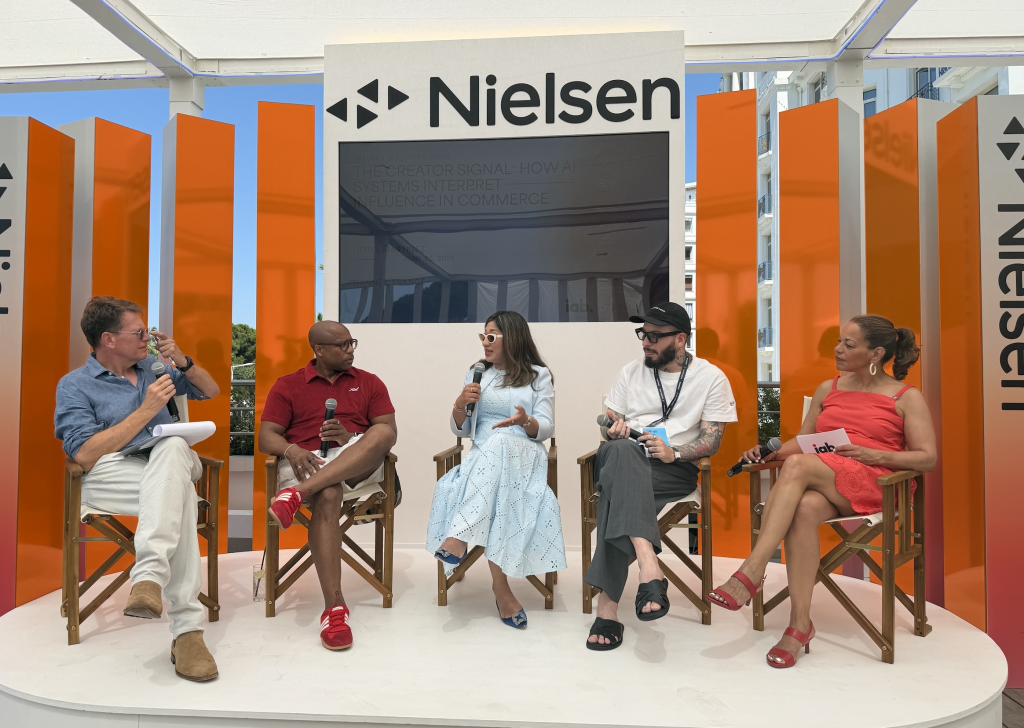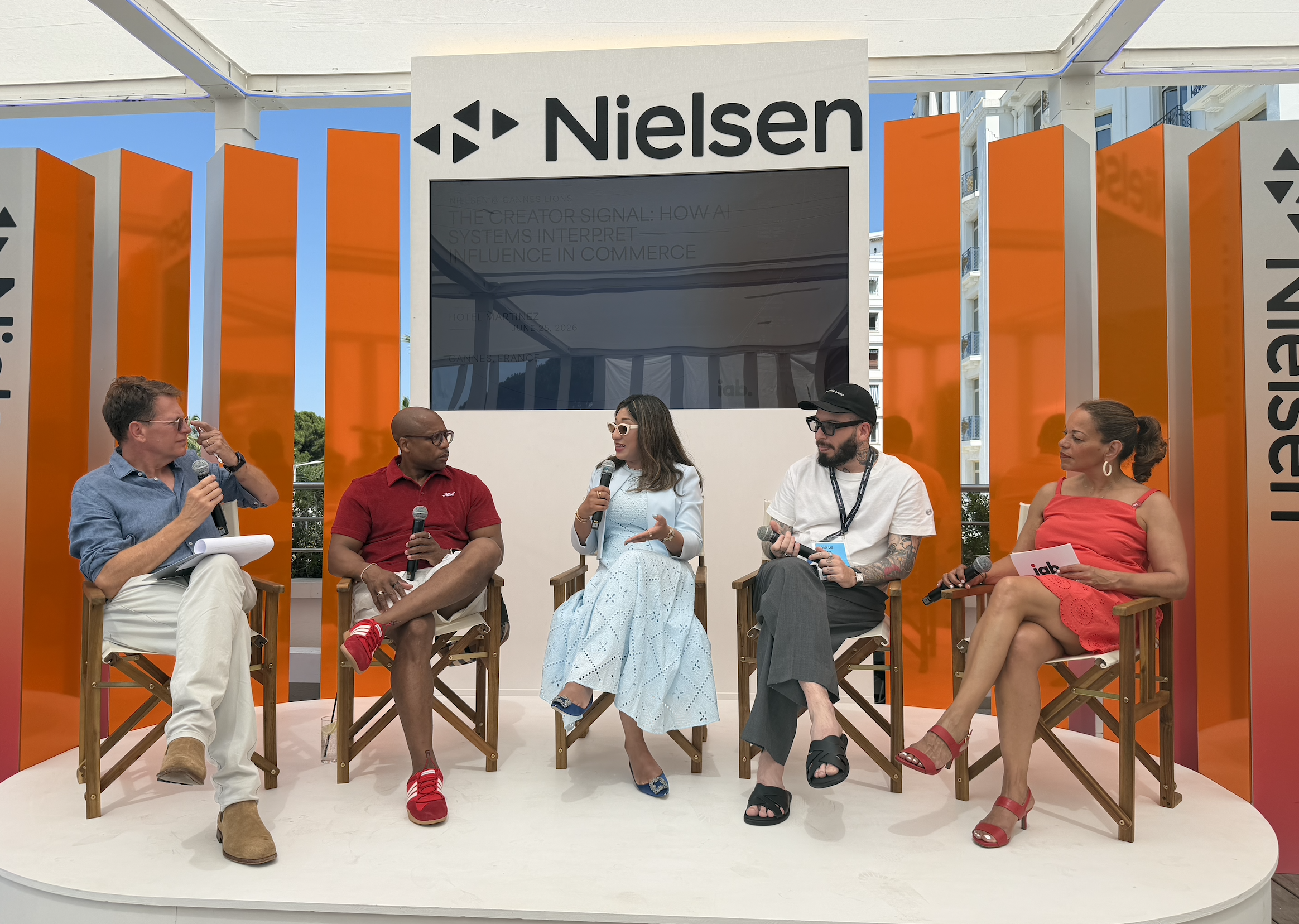
Consumers increasingly want shopping recommendations that combine artificial intelligence with human creators rather than relying on either one alone, panelists argued at a Nielsen-hosted session on AI and creator collaboration at Cannes Lions 2026.
The session was moderated by Trevor Fellows, Nielsen’s head of advertiser and agency relationships, who said that after a year away from the festival he had returned to find AI and creators had matured into mainstream tools for marketers.
“What was once hot and emerging is now hot and mainstream,” Fellows said.
The panel featured:
- Carryl Pierre-Drews, executive vice president and chief marketing officer at the Interactive Advertising Bureau
- Mohaimina Haque, global CEO of Tony Roma’s
- Paulo Aguiar, a digital creator who works with AI tools
- Damon D. Jones, chief communications officer at Procter & Gamble
The research at the center of the discussion
Pierre-Drews anchored the conversation in a global study she said the IAB had conducted on how consumers use AI when shopping. She told the audience the findings had not yet been published and presented them from her notes. According to the research as she described it, 56% of consumers prefer AI shopping recommendations that include a creator or influencer, rather than recommendations from AI alone.
Creator content now functions as an information layer beneath AI recommendations, Pierre-Drews said. Marketers have long valued creators for reach, she added, but the study pointed to credibility and validation as the newer currency.
The research, which Pierre-Drews said covered the U.S., U.K., Mexico, Australia and India, found uneven receptivity to creators. India and Mexico were the most receptive, she said, with consumers actively seeking creators for shopping advice. The U.S. was creator-centric, the U.K. more cautious and Australia in between. Her conclusion: No single global playbook applies.
On demographics, Pierre-Drews said younger consumers were more open to creator-driven AI recommendations, citing 65% among Gen Z and millennials and 34% among boomers, with receptivity declining across older cohorts. She also cited a narrow gap among Gen Z between trust in creator reviews and trust in brand-published reviews, which she put at 29% versus 27%.
The call for ‘Actual Intelligence’
Haque offered the panel’s most repeated line, redefining the AI acronym for her customers. “For us, AI stands for actual intelligence, not artificial intelligence,” Haque said.
She said diners want honest answers to practical questions about food, atmosphere and dietary needs, and that AI systems assemble those answers from reviews and creator content. Her stated aim was to shape that supply of information to win repeat customers rather than one-time visits.
Haque said Tony Roma’s had deployed robotic servers in some U.S. locations, where the machines run food while human servers take orders, make recommendations and deliver plates. The arrangement had produced higher tips rather than job losses, she said, framing it as a pairing of automation and human contact.
She also drew a contrast between audience size and influence, saying a creator’s reach is rented while trust compounds, and that someone with 5,000 trusted followers can outperform one with 100,000.
A creator’s view on change, trust and visibility
Aguiar, who builds content with AI tools, said the mechanics of the business had changed less than the discourse suggested.
“At the same time that everything is changing, nothing is changing,” Aguiar said, noting that social platforms have used AI to decide which content reaches audiences for years and that chatbots run on the same logic of signals, trust and relevance.
He spent his first year or two as a creator sharing his experience before making recommendations, and that trust has to come first. Aguiar changed his output in response to AI, writing longer text in his posts because text is what AI systems index and retrieve.
One of his team’s performance metrics is now how many clients find him through ChatGPT, he said, and he pointed to channels beyond the major social platforms, naming Reddit and public relations as factors in whether AI surfaces a creator.
Leading consumer brand company talks about accountability, authenticity and control
Jones said the shift mirrored long-standing human behavior, with consumers seeking validation from brands, trusted intermediaries and other consumers. He said the trend had raised the bar on consumer insight and content quality, and that brands increasingly treat creators as sources of insight rather than as media channels. That requires marketers to give up some control and to brief creators on objectives rather than dictate scripts, he said.
He was blunt about the volume of low-quality material competing for attention. “There’s a lot of crap out there right now,” Jones said. Brands can pursue every form of search and AI optimization, he cautioned, but sentiment in comments and reviews will expose a product that does not deliver, adding that marketers do not yet pay enough attention to that feedback.
Jones also warned that AI has lowered the cost of spreading false claims. “AI has the ability to insert doubt into the path to purchase,” he said, calling on brands and platforms to hold one another accountable.
On regional differences, Jones said markets were at different and non-linear stages, noting that China, Korea and Japan have used creators in commerce for years ahead of the U.S., and that Latin America embraced influencers in commerce earlier than American consumers did.
He added that brands should weigh a creator’s history and authenticity, and that audiences will abandon creators who appear to chase payments at the expense of consistency.
Closing recommendations
Fellows asked each panelist what advice they would pass to peers based on the week.
- Jones said brands need to plan to react to real-time cultural context rather than rely on annual calendars.
- Aguiar said creators should learn how AI reads their content and engage more strategically with brands.
- Haque urged executives to treat AI and creators as integrated parts of business strategy.
- Pierre-Drews closed by saying AI-assisted commerce would be won “by combining the simplicity of what AI can help us do … along with that trusted human person in the middle.” She added that she preferred a different framing from the one she had heard repeatedly at the festival, commenting: “Everyone’s talking about human in the loop. I actually think human-led sounds great.”