We in the United States recently celebrated our Independence Day. Our founders drafted and signed a document that declared a nation before it was a nation. The Declaration of Independence was a claim. It named the thing first and made everyone spend the next century arguing over whether the words were true.
There is another set of founders worth thinking about, and they did the same thing. They also wrote a founding document by naming something into existence before it existed.
The Birth of AI
In 1955, John McCarthy sat down to write a funding proposal for a study group (A Proposal for the Dartmouth Summer Research Project on Artificial Intelligence) at Dartmouth College. He coined a phrase that described no working system. “Artificial intelligence.” Two words that made a promise in a document shorter than this post. It asked the Rockefeller Foundation to fund a two-month study in the summer of 1956 involving a small group of scientists and mathematicians. The premise was “that every aspect of learning or any other feature of intelligence can in principle be so precisely described that a machine can be made to simulate it.”
The Rockefeller Foundation funded the proposal with a $7,500 grant, half the amount McCarthy and his co-authors had requested. While the funds would support research, the ask itself was an exercise in positioning.
The Name Was the Strategy
As the project and proposal leader, McCarthy rejected other suggested names. “Automata studies” sounded like a math seminar nobody would fund twice. “Complex information processing” was what Allen Newell and Herbert Simon (also participants in the project) called their own work. McCarthy chose his phrase specifically to separate the work from cybernetics and any ties to biology and animal behavior. He picked a name that sounded like a frontier. In the language of every communications and public relations leader, he was creating a category.
Positioning and messaging are part of the story and are extremely useful to anyone who hopes to make technology legible to a skeptical market. Dartmouth was the first time the AI label ran ahead of its ability, and it set the pattern that the industry has repeated ever since.
The Market Settles What the Name Promised
Once funded and convened in 1956, the research group could not build a system that performed natural language translation or common-sense reasoning. The chasm between the claim and the capability would not be crossed for decades. It produced two AI winters, the first from 1974 to 1980 and the second between the late 1980s and the mid-1990s, both defined by major collapses in financial backing and interest in AI because the market stopped believing the words.
Today, AI is running the same play with a bigger check attached. MIT’s Project NANDA found that despite $30 to $40 billion in enterprise spending, 95% of generative AI projects produced no measurable business return. Roughly 5% of pilots delivered a real revenue impact. This is the delta between what got sold and what was shipped.
“Agentic” Is McCarthy’s Move, Minus the Discipline
The word “agentic” has done exactly what “artificial intelligence” did in 1955. Agentic was the aspiration, marketed as a delivered feature. Gartner predicts more than 40% of agentic AI projects will be canceled by the end of 2027, citing escalating costs, unclear business value and weak risk controls. Gartner calls it “agent washing,” the rebranding of chatbots, robotic process automation and assistants as agents. It estimates that only about 130 of the thousands of vendors claiming agentic capability are building anything real. As a category, agentic AI sits at the top of the hype curve. Only 17% of organizations have deployed AI agents, yet more than 60% expect to within two years. That intent-to-reality gap is where the next round of cancellations comes from.
McCarthy and the other founders, including Marvin Lee Minsky of Harvard, Nathaniel Rochester from IBM and Claude Elwood Shannon of Bell Telephone Laboratories, would recognize the positioning and messaging instantly.
The Discipline Was Knowing the Name’s Purpose
“Artificial intelligence” was a wedge for obtaining funding and assembling talent. The discipline McCarthy practiced was ambition in the name and exactness in the lab notes. Much of the current market has collapsed that distinction. The name and the claim have become the same object, and a buyer can no longer tell whether the litany of AI-related names describes a capability or an aspiration.
A category name is meant to convey, via positioning and messaging, what a product or service does. A capability claim must survive the buyer’s evaluation. The 40% cancellation forecast is what happens when an AI vendor lets the positioning and messaging serve as the capability. The strongest positioning in AI is achieved when the messaging deliberately separates the category’s aspiration from the product’s evidence.
The Harder Question
Reserve the ambition for the label that opens the door. Let the specifics carry the weight once you are inside. Never confuse the two in your own head, because the market will do that job for you and charge you dearly for it.
As we celebrate the 70th summer of “artificial intelligence,” the Dartmouth group would ask whether we still know the difference between what we have named and what we have built.
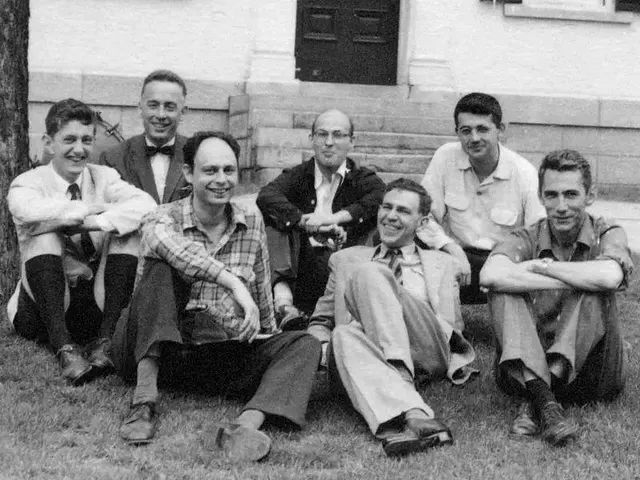
Featured image: Organizers and some participants of the 1956 Dartmouth Summer Research Project on Artificial Intelligence. In the back row, from left to right, are Oliver Selfridge, Nathaniel Rochester, Marvin Minsky and John McCarthy. In the front row, from left to right, are Ray Solomonoff, Peter Milner and Claude Shannon. (Photo/The Minsky Family)