AI has quickly become part of how many of us work. According to a Gallup survey conducted in February 2026, 50% of U.S. employees are using AI in the workplace. This is an increase from last quarter, where just 46% reported AI use. And as AI tools grow in capabilities, I wouldn’t be shocked if there was another single-digit percentage increase in use in Q2.
AI can be really helpful when you’re trying to organize your thoughts or find a starting point. It’s especially useful when you’re stuck and don’t know how to begin. But there’s a difference between using AI to get going and leaning on it too much, especially when it comes to writing.
Even though AI is being used more and more at work, McKinsey research shows that most people haven’t actually been trained on how to use it effectively day to day. As a result, many employees are left to figure it out on their own, often using AI in ways that aren’t as effective as they could be. Additionally, employees are often using AI in secret as they are unsure of how to leverage it to its full potential.
Whether we know it or not, we are increasingly seeing AI-generated content. We may not be told “this is AI-generated,” but it’s often easy to tell. Avoiding AI altogether isn’t possible, as AI adoption continues to grow across industries. So, it’s imperative to know how to use AI appropriately and where human judgment, voice and expertise still need to lead.
Why AI writing feels “off”
AI writing is fundamentally driven by probability, so it’s predicting the most likely next word based on the data sets it’s been trained on. That makes the output end up being very statistically average and feel uniform.
You’ll notice sentences tend to be a similar length, the rhythm stays very consistent, and the tone doesn’t shift much. Whereas human writing is a lot more varied because we are naturally mixing short and longer sentences, we change pace and we break structure. Because AI leans so heavily on patterns it’s seen over and over again, it tends to fall back on the same transitions, phrasing and paragraph structures. None of those are issues on their own, and AI writing limitations are subtle. But together, the writing starts to feel more templated than thoughtful, causing people to think, “Hmm, maybe AI wrote this.”
Once you know what to look for, AI writing becomes easy to spot. AI tends to be overly polished but under-specific, writing in a very generalized tone because it’s trying to apply to everyone.
That often shows up as broad statements that sound right but aren’t grounded in anything concrete. You’ll also start to notice repeated phrasing and familiar sentence structures, such as clean, balanced comparisons or lists that follow the same rhythm from paragraph to paragraph.
Additionally, AI can sound confident while being wrong, which is why it’s so important to always double-check claims, statistics, examples and sources to ensure that AI is not hallucinating. AI also tends to over-explain simple ideas, adding extra context or transitions that make the writing longer without making it any more insightful. Because the tone stays so consistent, without much shift in emphasis or perspective, the writing can start to feel flat over time.
Common characteristics of AI writing
AI relies on familiar phrases and structures. You’ll see openings like “in today’s rapidly evolving landscape” or “it is important to note,” which aren’t incorrect but feel overused and easy to recognize. It also tends to default to vocabulary that sounds polished but isn’t very specific, using words like “leverage,” “optimize,” or “enhance” in ways that don’t add clarity. Over time, this creates writing that feels like it could apply to almost any topic, rather than something tailored and intentional.
Sentence structure is another major tell. AI tends to favor very clean, formulaic constructions like “it’s not X, it’s Y.” It also frequently relies on lists of three, for example, “efficiency, scalability and flexibility,” because those patterns show up so often in its training data. While these structures can be effective in moderation, overusing them makes the writing feel mechanical rather than natural.
Techniques to humanize AI content
Now that we know what AI writing looks like, the next question is: How do you fix it?
Humanizing AI content means editing the thinking behind the writing. It extends beyond swapping out vocabulary to editing the structure, perspective and intent.
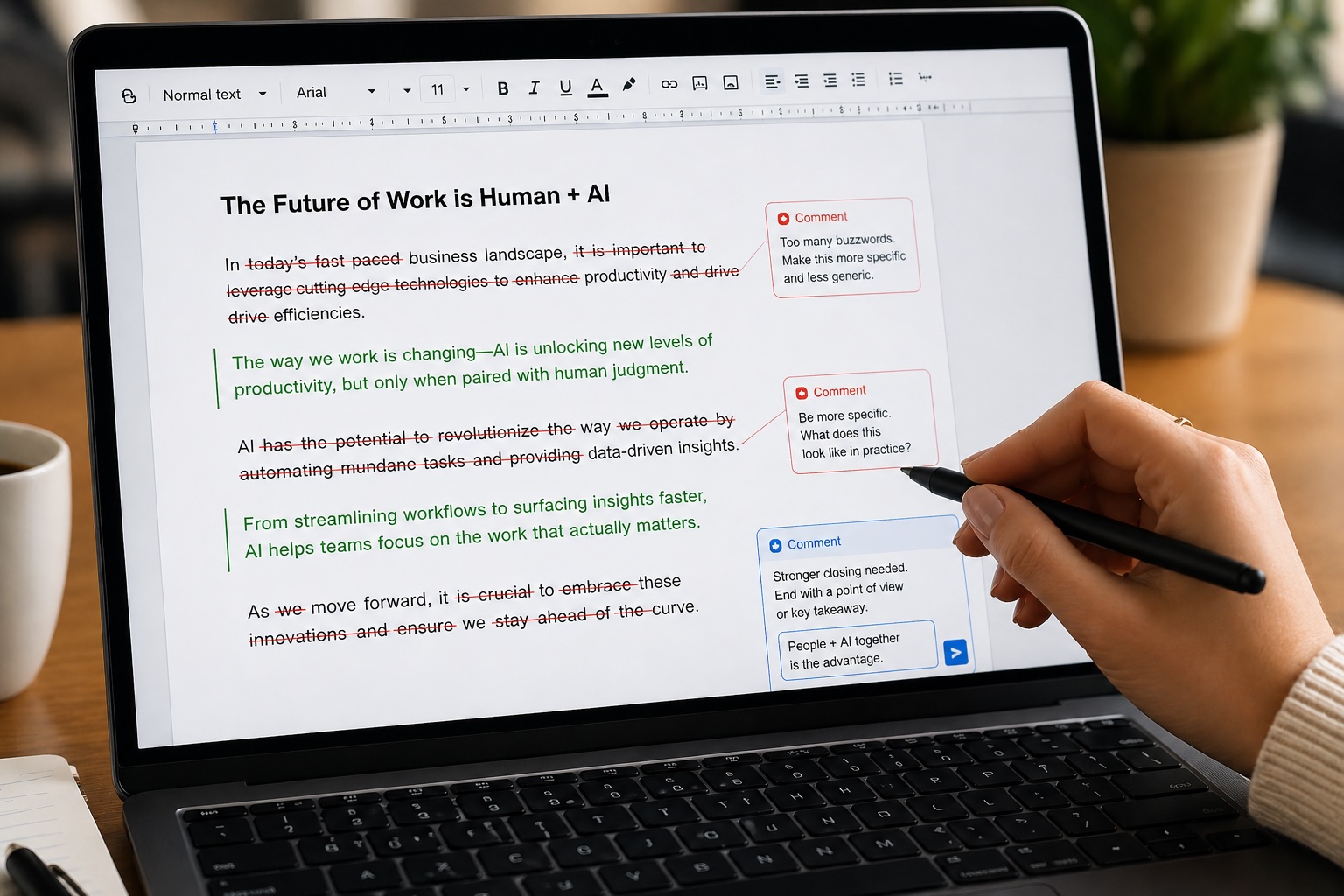
One of the easiest places to start is with specificity. AI tends to open very broadly, easing into a topic in a way that feels safe but not particularly interesting. A simple but effective shift is to start with a clear, concrete point to anchor the reader immediately.
From there, perspective becomes critical. AI naturally avoids taking a stance, defaulting to neutral, balanced language. Human writing, on the other hand, almost always reflects a point of view (even if it’s subtle). That might mean using first person, implying experience or simply sounding like you’ve thought about the topic you’re writing about.
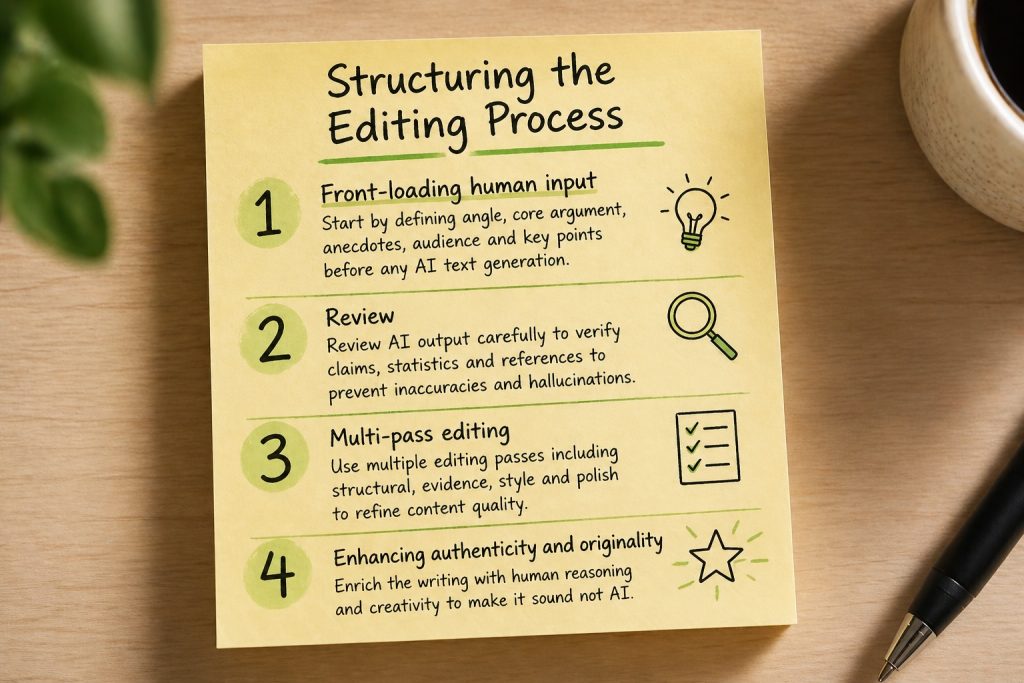
Before even getting into word-level edits, it’s also important to step back and look at structure. Does the piece flow in a way that makes sense? Are the main points clear? Do the examples support the argument? If the structure feels too clean or too predictable, it will still read as AI, even if the sentences themselves have been edited.
Beyond that, one of the most effective ways to improve AI-assisted writing is to bring your thinking in earlier. Instead of starting with a blank prompt and hoping the tool comes up with something strong, it helps to define a few things upfront, especially the angle, core argument, audience and any anecdotes that should be included. Without that direction, AI will almost always default to something generic. The more you layer in your own reasoning, judgment and real examples, the more the writing starts to feel intentional rather than generated. This is a core part of humanizing AI content for professional audiences.
AI is a useful tool that is here to stay. But it’s not a replacement for thinking, and it’s definitely not a replacement for voice. When it’s used as a starting point, it can really help move things along. But when it becomes the final product writing starts to feel flat.
Strong writing still comes down to clarity, judgment and intent. Those are human decisions.
AI can support them, but it can’t make them for you.