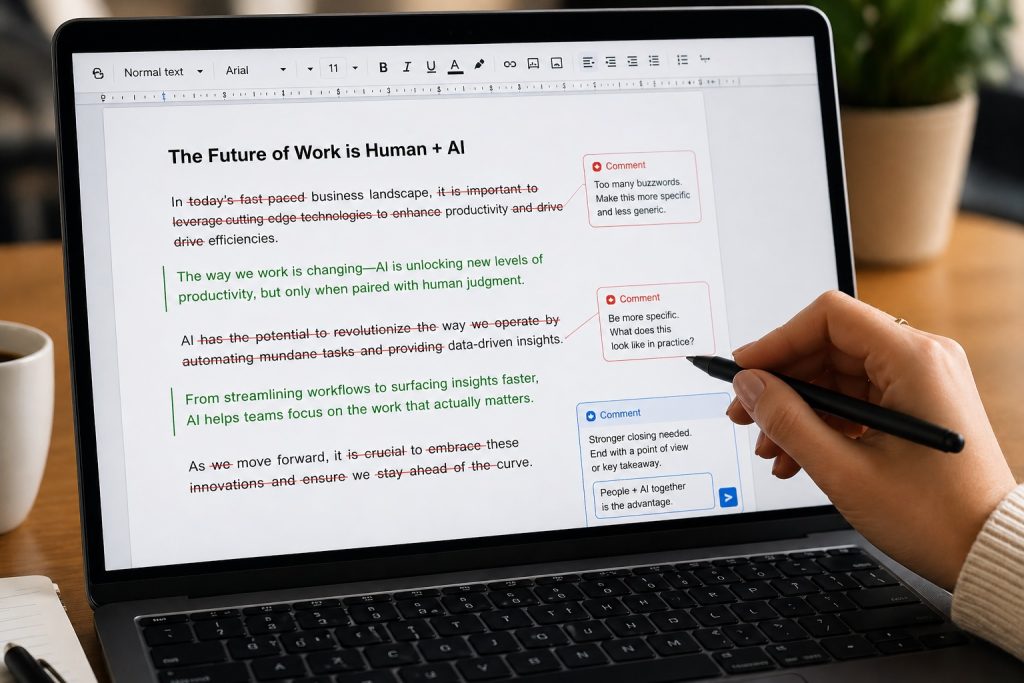
There’s a moment in every PR professional’s career when you type out a pitch, read it back and realize you’ve written something that could have come from literally any company, in any industry, at any point in the last decade. “Our innovative, industry-leading platform leverages next-generation technology to disrupt…”
Disrupt what, exactly? The journalist’s willingness to keep reading?
At Bospar, we write, review and send a lot of pitches across various industries, and we’ve seen what lands and what gets deleted before a reporter even finishes the subject line.
So I asked some of the sharpest media whisperers a simple question: What’s the one buzzword or phrase that makes you cringe the most, and what do you do about it?
Their answers didn’t disappoint!!!
Writing pitches that get media coverage: Stop making it about you
Brent Shelton, Bospar’s vice president of media relations, didn’t share a single word. He pointed out a habit, and it’s one that most of us are guilty of without even realizing it.
“I wanted to XYZ or I thought you might XYZ. A pitch should always be about who you’re pitching to, not you,” Brent said. “Make it clear it’s about them. Use phrases like ‘sharing for your interest’ or ‘if you are interested’, instead of ‘I wanted to see,’ which is quite obvious since you sent the pitch to begin with.”
“That one small shift can change everything.”
Brent then warned against using “I hope” because that’s not a good PR strategy if you have to hope, or make it known that hope is the best you have.
“Hope is not a good PR strategy,” isn’t just Brent-ism. It came from a senior executive at NBC who oversaw news content across their U.S. stations. That relationship, Brent says, launched his PR career into another league and generated thousands of media hits over several years. All because he stopped hoping and started delivering exactly what a newsroom needed.
The lesson is deceptively simple. Every pitch that opens with “I” sends a subconscious signal: This email is about me. Flip it. Make the first word about the reporter, their audience or the story that’s unfolding right now. That one small shift changes everything.
The words that mean nothing and how to shift to outcome-focused pitch writing
Brent’s advice is about structure. But many other colleagues zeroed in on words themselves, the ones that sound impressive in a draft and dissolve into air the moment a journalist reads them.
Ryan Quintana, Bospar account director, kept his answer tight: “Innovative and leveraging are two words so overused they’ve become invisible. When every company is “innovative” and every strategy “leverages” something, neither word is doing any work. They’re just filling space.
Emily Roberts, Bospar senior account director, called out the grandaddy of them all: “Disrupt.” Her fix? “I usually change it to ‘impact XYZ, which will result in XYZ.'” In other words, replace the vague with the specific. Don’t tell a reporter your client is disrupting an industry. Tell them what’s actually changing and for whom.
Greg Allen, an account manager at our PR agency, agreed, calling “disruptive” his least favorite word. Then he shared these PR writing tips for media outreach: “Don’t even swap it. Just remove it.” Hard to argue with that kind of clarity.
Caroline Kamerschen, our public relations firm’s director of media relations, landed on “groundbreaking” and “first-of-its-kind.” But her real point about PR copywriting and pitch personalization goes deeper than any single word. “In general, any hyperbolic or flowery language that reads too much like marketing or AI. Journalists want the facts, and it’s our job to prove them with all the essential information they need to build a story.”
That’s the part worth sitting with. Reporters can now spot AI-generated fluff at a glance. Pitches loaded with empty superlatives sound lazy and may come off as if they were written by a machine. Nothing kills credibility faster than a pitch that reads like it came from a prompt instead of a thoughtful person.
Diana Puckett, a tech B2B PR veteran and Bospar senior account director, flagged a subtler offender: “enables.” It doesn’t sound like a buzzword, which is exactly why it sneaks into so many pitches unchecked. “Every time I write it, I take a step back and ask myself: What does it actually do?” Diana said. “Media often care about the bigger outcomes or what’s changing in the landscape. For certain reporters, I find skipping what it enables and getting straight to the outcome works better. Not ‘enables faster decision-making’ but ‘cuts decision time in half.’ That’s the better headline.”
She’s right. “Enables” is the polite way of not committing to a result. It keeps the pitch one step removed from the impact, and reporters don’t write stories about things that are one step removed from anything.
Cutting filler words from press outreach
Sam Brancato, Bospar senior account director, offered what might be the most useful editing principle of the bunch, what you might call the take-it-out-and-nothing-changes test: “My go-to is to strike anything that, if you took the word out, wouldn’t make a difference in the sentence.”
She rattled off a list of offenders: “one of the top,” “industry-leading,” “groundbreaking,” “next-generation.” These are words that feel important when you’re writing, but add zero information for the person reading. “I feel like anything that softens what we’re saying is what I change most of all,” Sam said. That’s especially important in PR writing for tech companies, for which clarity is particularly important.
Try it yourself. Take your last pitch, delete every adjective that could apply to any company in any sector, and read what’s left. If the pitch still works, those words were dead weight. If it doesn’t, you’ve just discovered that the pitch didn’t have enough substance to begin with, which is a far more useful thing to know before you hit send.
How to make a pitch more specific and compelling
The thread that connects every one of these answers is specificity. The cure for buzzwords isn’t better buzzwords. It’s facts, outcomes and clarity.
Instead of “innovative,” name what the product actually does differently. Instead of “disrupting the industry,” point to a number, a customer result or a market shift. Instead of “I hope you’ll find this interesting,” think about what makes a good media pitch and give the reporter a reason to care in the first seven words.
Here’s a quick cheat sheet:
- Innovative becomes a specific capability or differentiator. What does it do that others don’t?
- Disruptive/groundbreaking becomes a measurable outcome. What changed, by how much and for whom?
- Industry-leading becomes a proof point. Are you the biggest? The fastest? Backed by data? Say that instead.
- Leveraging becomes using. Seriously. Just say using.
- I wanted to reach out becomes a direct value statement for the reporter. Lead with why this matters to their readers.
- Next generation becomes what’s actually new. If you can’t explain it without the buzzword, you might not understand it well enough yet.
How do reporters decide which pitches to cover?
None of this is about policing language for the sake of it. It’s about respecting the person on the other end of the pitch. Journalists are drowning in emails. Every vague, padded, buzzword-loaded sentence is a tiny invitation to move on.
The best pitches read like something a smart person would say out loud to another smart person. No jargon. No inflated language. Just a clear, compelling reason to pay attention.
So before you hit send on that next pitch, read it back one more time. If it could have been written by any agency, for any client, in any year, it’s not ready. A sharp, specific, reporter-first pitch that earns its place in an overcrowded inbox is the one most likely to get the reply.