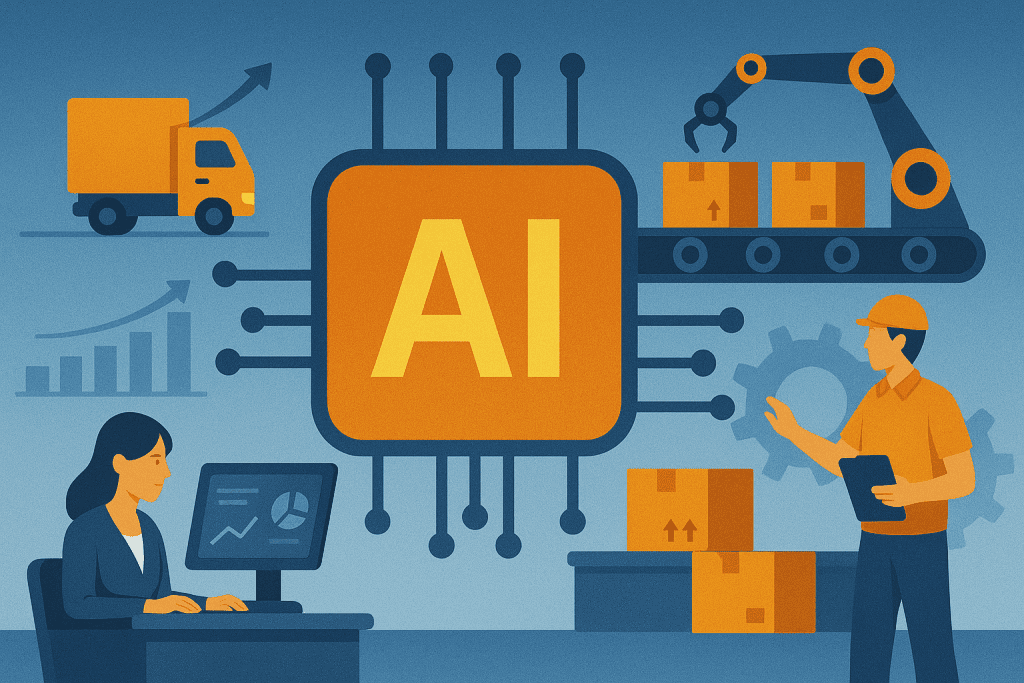
AI is no longer a future-state ambition for supply chains; it’s the operating system for resilience, speed and competitive advantage. As geopolitical volatility, labor shortages and cost pressures collide, leaders are discovering that incremental optimization won’t cut it. What separates the winners isn’t experimentation, but execution: how fast organizations move from pilots to platforms, from dashboards to decisions and from human-only workflows to human-plus-AI orchestration. This issue explores AI’s adoption in supply chains, how leaders are translating strategy into measurable performance and why the most profound impacts of AI won’t show up neatly on a spreadsheet, but will reshape talent, governance and trust across global networks.
Why AI Is No Longer Optional
AI is transforming supply chain management at unprecedented speed, leaving organizations that fail to adapt at a competitive disadvantage. For chief procurement officers (CPOs) and their peers, the question is no longer whether to embrace AI but how quickly and effectively they can do so. Rapid but thoughtful adoption is now a strategic imperative.
In today’s climate of geopolitical and economic uncertainty, optimizing processes and technology to improve visibility and resilience is critical. While nearly 90% of companies report using AI in at least one business function, adoption in supply chain and inventory management remains low at just 12%. Procurement and category management functions are among the slowest to adopt. According to The Hackett Group’s 2025 CPO Agenda, only 30% of procurement teams use generative AI tools like Microsoft Copilot, leaving 70% yet to begin their AI journey.
Thirty-nine percent and the Cost of Waiting
The global supply chain AI market is valued at $9.9 billion today and projected to reach $192 billion by 2034, a compound annual growth rate of 39%. AI in the supply chain is advancing three times faster than general enterprise applications, making it one of the most significant technology shifts in modern business.
The financial upside is enormous. IBM reports AI-driven category management and predictive analytics can cut procurement costs by 40% to 70% within six months and accelerate supplier onboarding tenfold. AI procurement platforms have delivered billions in customer savings through agentic procurement orchestration.
Beyond cost savings, AI enables procurement leaders to balance supply assurance with cost efficiency. Advanced AI systems now monitor tens of thousands of suppliers across global networks, analyzing thousands of up- and downstream risk signals daily, including those for inventory positions, lead times, supply base concentrations, demand and design dimensions, transportation and logistics disruptions, weather patterns, labor dynamics, compliance and regulatory requirements, geopolitical instabilities, tariff and trade policies, economics and so much more.
Before Rewards, Come Responsibilities
By integrating various traditional supply chain technologies with AI, including enterprise resource planning, product lifecycle management and procure-to-pay systems, orchestration can enable procurement teams to plan, execute and monitor their end-to-end processes. But capturing the reward demands more than a software purchase. Organizations that have moved beyond pilot programs treated AI adoption as an operating model transformation, not simply as technology implementation. That means confronting uncomfortable gaps in talent, data infrastructure and organizational readiness, areas where most procurement functions remain vastly underprepared.
- Closing the knowledge gap
The challenge begins at the top. CPOs and their leadership teams face an urgent need to build fluency in generative and agentic AI as a strategic imperative. These technologies are reshaping procurement workflows, supplier collaboration and decision-making. Without a clear understanding of AI’s capabilities and limitations, leaders risk falling behind in both efficiency and competitiveness.
- Competing for scarce talent
Nearly 70% of supply chain organizations struggle to recruit qualified data scientists and AI specialists, with salaries commanding a 35% premium for candidates combining technical and domain expertise. These roles are critical for predictive analytics, autonomous decision-making and real-time risk management.
- Redesigning human-machine collaboration
Companies that invested at least 15% of their AI project budgets in training and change management reported 2.8 times higher adoption rates and 3.5 times higher return on investment.
- Fixing foundational data
AI systems are only as effective as the data feeding them, yet many supply chain teams struggle with inconsistent supplier records, incomplete spend data and siloed analytical information systems.
- Establishing success metrics
Leaders must expand AI success metrics beyond cost savings to include speed, resilience and workforce impact. Clear frameworks are needed for measuring AI’s impact. The measurement framework itself becomes a change management tool, making AI’s value visible and building organizational momentum for broader adoption.
The Bottom Line Is The Bottom Line
Implementing AI in supply chains is complex, almost as complex as supply chains themselves, but the organizations that act decisively will define the future. The 39% revolution is here, and those who hesitate will jeopardize their bottom lines.
Key takeaways:
- AI in supply chains is accelerating faster than enterprise tech; waiting is now the biggest risk
- Real value comes from operating-model change, not standalone AI tools
- Data readiness, talent and change management determine ROI
- Clear success metrics turn pilots into scale
How Leading Supply Chains Are Executing AI at Scale
Only 23% of supply chain organizations have a formal AI strategy. But for other global supply chain players, AI in supply chains has evolved from pilots to a powerful source of competitive advantage. Companies that effectively deploy AI in their supply chain organizations reap benefits like 20% faster planning cycles and 15% to 20% improvements in responsiveness during disruptions, empowering leaders to shape future success.
“From our experience across multiple industries, it is clear that the supply chains winning today aren’t just adopting AI, they’re executing it with discipline,” said Ami Atha, account director at Bospar. “They start with high-impact use cases, build internal expertise and measure everything. That’s what separates experiments from real returns.”
Below are six established strategies that leading organizations are using to harness AI for superior supply chain performance.
- Target High-Impact Use Cases
Successful AI initiatives start with specific objectives that expand into broader targets. Agentic AI is now driving efficiency gains for UPS. The agent, ORION, makes autonomous decisions as it processes billions of data points daily, continuously learning and improving. Initially, as a static route-optimization AI deployment, it analyzes more than 200,000 routes per driver per day. In 2024, ORION was put on the road, driving an annual reduction of 100 million delivery miles and a projected $400 million in cost savings for 2025. - Scale AI Through Centers of Excellence
Organizations achieving the highest returns concentrate AI expertise in dedicated centers of excellence (COEs). A 2025 McKinsey study found that one industrial OEM generated $370 million in first-year savings with its COE model. A specialty chemicals company using centralized should-cost modeling achieved 13% savings on raw materials. Unilever exemplified this approach by implementing more than 500 AI-based capabilities across its global operations. The company trained 23,000 employees in AI usage by the end of 2024 and established one of the first AI-focused research hubs in the consumer goods industry. Unilever’s Manufacturing System, now active in 124 factories spanning 2,100 production lines, has delivered a 3% increase in overall equipment efficiency, 5% rise in labor productivity and 8% reduction in costs across all implementation sites. - Improve Demand Forecasting Accuracy
Inventory optimization depends on forecast accuracy. Better forecasts translate directly to reduced inventory carrying costs, fewer stockouts and higher customer satisfaction. Retailers using AI to project demand have reduced stockouts and markdowns while improving service levels. General Mills reported more than $20 million in savings since fiscal 2024 through AI-driven demand sensing, with projections targeting $50 million in waste reduction. The company achieved a 40-percentage-point improvement in forecast accuracy. - Optimize in Real Time
Static planning models become ineffective when operating in environments with significant volatility. Agentic AI systems now simultaneously analyze demand, inventory and other operational variables. One multi-agent platform integrates ERP data with external signals and delivers proof-of-concept results in two hours, improving forecast accuracy by 20%. This is essential when production lead times span weeks, and up to 30% of costs are lost to testing and yield issues. This capability allows companies to pivot instantly when disruptions occur, maintaining service levels and profitability. - Embed Risk Intelligence
Supply chain disruptions cost companies billions annually, making risk prediction and mitigation a high-value AI application. Samsung Electro-Mechanics engaged in proactive risk mitigation by restructuring its substrate supply chain and using AI to predict material availability with 95% accuracy. As substrate lead times extended from 8 to 12 weeks to 20 to 26 weeks, real-time risk intelligence became a critical differentiator. AI supply chain visibility platforms in healthcare helped scale vaccine production to 1.9 billion doses, shipping 1.5 billion in months through supply chain modeling and securing raw materials early. - Measure ROI Rigorously
Transparent measurement builds confidence and accelerates AI scaling. It is critical to develop KPIs for forecast accuracy, cycle-time reductions, logistics cost, service levels and disruption avoidance. Organizations that use strict outcome measurement methods will achieve superior results than organizations that do not. Compared to traditional methods, 50% of AI-driven procurement teams doubled their ROI, with some achieving returns of 5 times or more. The methodical approach enables organizations to attain actual value from their AI investment programs.
From Complexity to Clarity
Global supply chains are more complex than ever, but AI is turning that complexity into clarity by delivering capabilities that traditional methods simply cannot match. In an era defined by rapid change and volatility, AI enables more thoughtful decisions, faster responses and greater resilience.
Organizations that fully embrace AI are achieving breakthroughs in demand forecasting, real-time optimization and risk management. These capabilities reduce waste, cut costs and improve service levels. Disciplined execution is paramount. Enterprises must focus on high-value applications, build strong internal expertise and consistently measure outcomes. When these elements come together, AI transforms supply chains from reactive systems into proactive engines of growth.
Key takeaways:
- Winning teams start with high-impact AI use cases, then scale fast
- Centers of excellence convert AI ambition into repeatable results
- Real-time optimization outperforms static planning in volatile markets
- Measured outcomes separate AI experiments from AI returns
What AI Is Quietly Changing That Leaders Aren’t Tracking
Every boardroom pitch on AI sounds identical: faster decisions, lower costs, bigger margins. Meanwhile, a more profound transformation is unfolding in warehouses, planning rooms, procurement desks and supplier networks worldwide. AI is impacting who decides, what skills matter, how trust is built and how organizations show responsibility in global commerce.
Skill Set Reset
Automation and AI are reshaping expertise, requiring organizations to focus on strategic talent development and ethical competence. “The Future of Jobs Report 2025” from the World Economic Forum reveals 63% of employers cite skills gaps, not access to technology, as the main barrier to transformation, highlighting the need for a broader approach to workforce evolution. Encouragingly, 70% of HR professionals say their organization is prioritizing upskilling initiatives in 2025 to build skills from within.

When Algorithms Negotiate
An AI agent has autonomously negotiated contracts with 3,000 suppliers and secured millions in savings at a Fortune 500 company. This signals a profound shift in decision-making roles.
Agentic AI is expected to disrupt nearly 50% of procurement activities within five to seven years. Already, 53% of supply chain executives are enabling autonomous automation through self-sufficient AI agents. These systems don’t just recommend actions; they reroute shipments, negotiate with suppliers and mitigate risks in real time without waiting for human approval. The question of who actually makes decisions in your supply chain is no longer straightforward.
Shadow AI
While executives debate AI strategy, employees are already using it, often without permission and frequently without oversight. One in five organizations has already experienced breaches due to unauthorized AI tools used by staff. These shadow AI incidents can make leaders feel vulnerable and underscore the need for proactive security measures.
Only 37% of organizations have processes in place to securely govern AI use, while 63% either lack governance policies entirely or are still developing them. Of those with policies, only a third conduct regular audits for unsanctioned AI tools.
Locks Are Only To Keep the Good People Out
Supply chain cyberattacks increased 431% between 2021 and 2023. AI is accelerating this trend in both directions. AI systems’ reliance on third-party libraries, datasets and cloud services creates new backdoors throughout interconnected networks. If a single supplier’s AI is compromised, vulnerabilities cascade across the entire ecosystem.
Organizations must now “know your supplier” for AI, just as they do for physical goods, by mapping data provenance, validating model integrity and identifying concentration risks that traditional security frameworks never anticipated. The most common entry point for AI-related breaches is compromised applications, APIs and plug-ins within the AI supply chain itself, with 60% of incidents leading to data compromise and 31% causing operational disruption.
Ethics and Autonomy
Smriti Shakargaye, account leader at Bospar, indicates, “Autonomous errors don’t stay contained. One flawed decision triggers the next. That’s why accuracy, trust and ethics can’t be an afterthought. It has to be the foundation.”
When an AI agent decides which supplier wins a contract, who is accountable if that decision reflects hidden bias? While AI enhances operational efficiency, its use raises significant ethical concerns around data privacy, transparency and algorithmic bias that most organizations have barely begun to address. Centralized AI governance boards overseeing security, ethics and compliance are essential, yet few companies have established them. The questions multiply: Should AI systems be required to explain their decisions? Who audits for bias when an algorithm is a black box? What happens when an autonomous agent makes a choice that violates company values but maximizes short-term returns?
Beyond the Balance Sheet
The supply chain AI revolution isn’t just about moving goods faster or cutting costs deeper. It’s about fundamental changes in organizational power structures, professional roles, security strategies and ethical responsibilities, urging leaders to view AI as an operational workflow and workforce transition rather than merely a technology upgrade.
The balance sheet will catch up. The organizations being reshaped today won’t wait for it.
Key takeaways:
- AI is shifting decision-making power from people to autonomous agents
- Skills gaps, not technology, are slowing transformation
- Shadow AI and cyber risk demand stronger governance now
- Ethics and accountability become critical as AI autonomy grows