
Technology marketing professionals are now integrating AI tools into their everyday routines.
Many ask: “Why do I need analyst relations when I can just ask AI?”
ChatGPT, Gemini and Perplexity are summarizing questions on market trends, competitive landscapes and business planning. Is it still important to engage with Forrester and Gartner?
The “relations” in analyst relations matters
Yes, AI is disrupting the analyst industry. Forrester and Gartner are both dealing with this reality head-on, and their stock prices show it. The bigger reality: Analysts do more than analyze.
Analysts close a validation gap that AI can’t.
Why does it matter? B2B buying committees aren’t getting smaller because of AI. They’re already big and getting bigger. They’ve grown from a handful of decision makers decades ago to an average of 13 to 20 people today. That’s a lot of sign offs on major purchases. When an enterprise is buying technology that costs millions of dollars and impacts business strategy, purchasing committees don’t want to be relying on what a large language model (LLM) hallucinated. Analysts source primary data and peel back the reality of technology in the market when they evaluate markets. That’s the gap AI can’t fill.
An LLM regurgitates past information. An analyst provides forward-looking strategic guidance based on data and patterns across hundreds of companies in your market. As a marketing manager, you’ve got to build the relationships that showcase your strengths and differentiation.
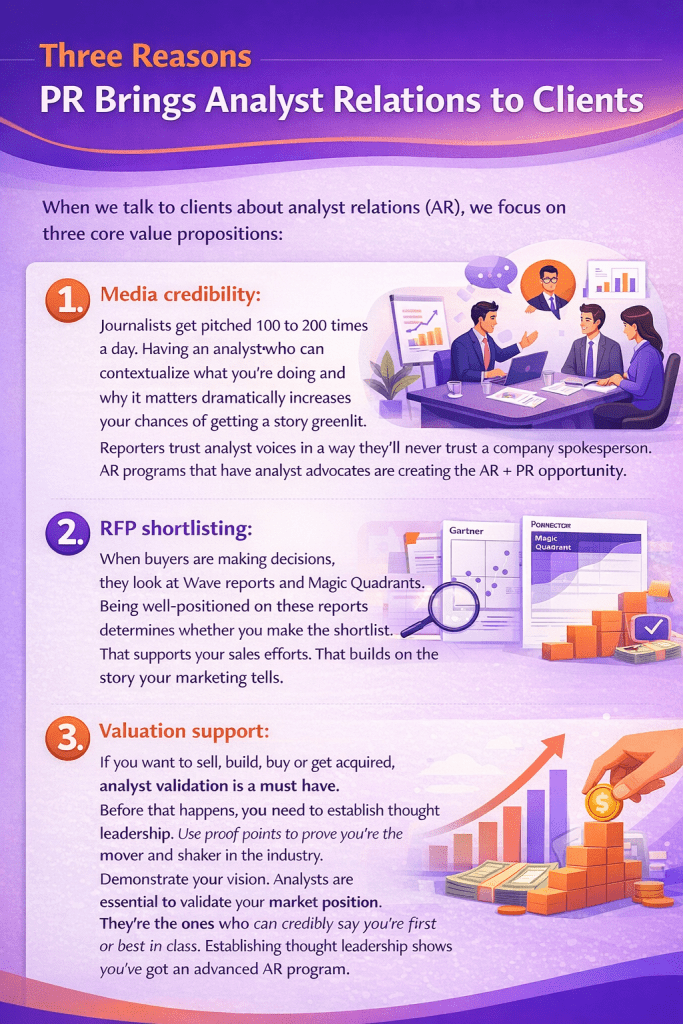
Establishing Thought Leadership requires Deeper Ties
Most public relations experts only scratch the surface on this. Marketing professionals in-the-know understand that the real value comes from advisory work.
Former Forrester analyst Henry H. Harteveldt, president of Atmosphere Research Group, explains: “Credible, professional analysts conduct original, objective, extensive research. Not all of an analyst’s research is published or made publicly available, and that’s intentional. By design, analysts prefer to share detailed results of their research privately with clients. A private discussion allows for open, honest, unfettered discussions about products and their benefits (and drawbacks), price or costs, other customers’ views about a product or provider, providers’ product or technology roadmaps, and providers’ reputations for on-time delivery, customer support. Add to this analysts’ additional research, such as consumers’ or users’ behaviors and attitudes, and an analyst’s research value becomes even more important. Because all this information is generally shared in a confidential manner, it’s much less likely to be discoverable by AI bots and thus surfaced in AI searches.”
Entering paid relationships and subscriptions with industry analyst firms can help you shape your product and business strategy and walk you through implementing major initiatives. They can also advise you on market expansion, acquisition, offer partner recommendations, help you decide where to invest over the next five years, and position you as the rock star CIO or CMO.
Beyond influence, analysts create value by speaking daily with buyers, market-making vendors and your competitors. They connect with investors, financial analysts and conduct customer reference calls. They build a perspective that informs strategic planning better than any AI model can replicate. Even when an analyst isn’t shaping buyer decisions directly, their insight can serve to assist your public relations and other teams to sharpen your messaging, identify blind spots and guide priorities before a product ever goes to market.
AR Best Practice: Engage with Industry Analysts Early
Most companies use analysts reactively. Something launches, so they brief the analysts.
That’s backwards.
The highest-performing AR programs engage analysts early. Keep analysts aware and create a narrative of your company, much like PR. Treating analysts like strategic advisors is a next step to pressure-test assumptions and validate direction before decisions are locked in. This forms a relationship that allows information sharing and demonstrates thought leadership in the market.
The smart approach is defining your business objectives first.
- Looking for an evangelist who can speak credibly about your category?
- Competing for market share and participating in evaluations?
- Launching a new product and need to understand unmet needs?
- Expanding into a new market with new sales or marketing strategies?
- Looking at M&A or IPO opportunities?
Ideally, you have multiple relationships established to address a myriad of questions. AR is a long game and keeping analysts in the loop makes them invaluable resources when decisions need to be made.
The Influencer Economy Gets Bigger, Not Smaller
Another thing you may find surprising: Even as AI tools proliferate, the role of influencers in B2B decision-making is growing.
When procurement is playing a bigger role and buying committees are expanding, executives want air cover. They want to know that respected third parties validate their choices.
Bringing AR and PR together magnifies your reach into the influencer economy.
Companies that understand this invest in AR as a strategic function, not just a PR tactic. They’re engaging early to build relationships, sharing ideas to build thought leadership and defining clear objectives to leverage more of what analyst firms offer.
Organizations waiting to see if AI makes analysts obsolete will be playing catch-up for years.
Getting Started
Keep in mind that building an analyst relations program requires outreach to different analyst firms. Build strategic relationships with analysts that understand your market, your business and can influence based on your goals.
AI can give you information, but analysts can give you strategic advantage.
In this market, strategic advantage is what keeps you in business.