I did something dangerous last week.
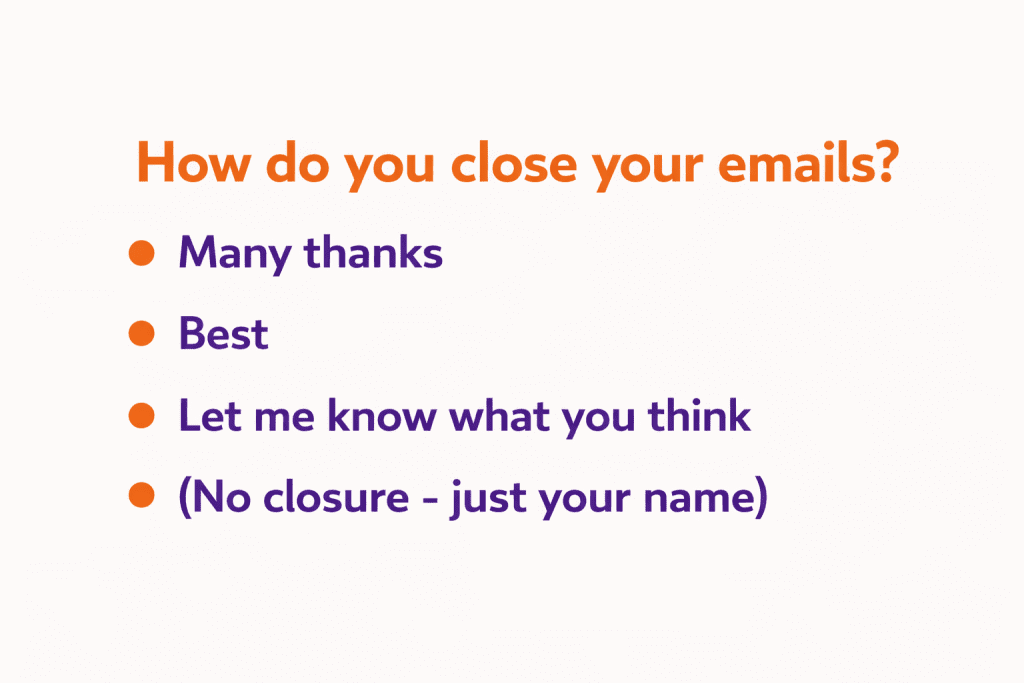
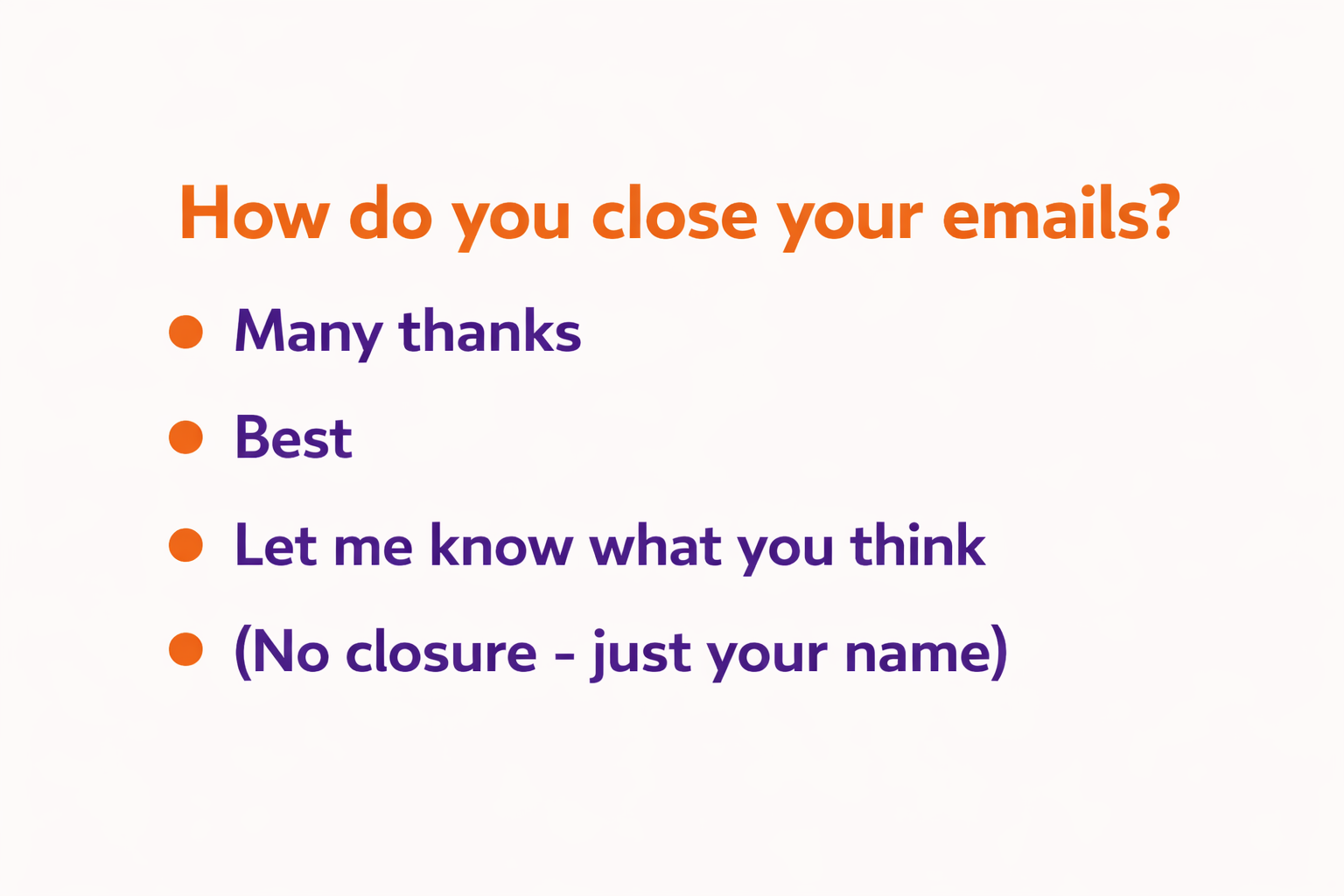
I asked LinkedIn a simple question: “How do you end your emails?”
Sixty-eight votes and 30 comments later, I have a lot of opinions in my inbox about email sign-off etiquette, and more than a few feelings about the cultural politics of professional sign-offs.
My exploration of email etiquette and workplace culture started innocently enough.
A friend of mine from Los Angeles ended an email with “Many thanks.”
What does “many thanks” mean in an email?
In my world, “Many thanks” belongs to my very polite British friends, people who say “brilliant” when they mean “mediocre” and apologize before telling you that your building is on fire.
Seeing it from an Angeleno felt like spotting someone in a tuxedo at a taco stand.
Charming, but jarring.
When I called her on it, she revealed that “Many thanks” was baked into her company email signature. It was a permanent email communication fixture, regardless of context or tone.
That means somewhere out there, someone is firing off an enraged email about a missed deadline and closing with “Many thanks.” God help us all.
Wanting to learn more, I put professional email closings to a vote.
Here’s what the internet decided:
- “Best” = 68%
- “Many thanks” = 15%
- No closing, just your name = 13%
- “Let me know what you think” = 4%
“Best” won in a landslide, which feels right.
It’s the khaki chinos of email closings. This professional communication choice is inoffensive, universally accepted, endlessly versatile. And, as one commenter noted, slightly maddening.
Dave Moore explained that his former boss signed every email “Best.” Every time he read it, he thought: Best what, exactly? She had certainly never demonstrated it. A word stripped of context becomes either a promise or a taunt.
Reading between the lines reframes email closing phrases and their meanings.
The comments were more colorful than the poll.
Some email closings signal cultural differences.
Liz Harris, representing the Crown, delivered the definitive British translation guide: “‘Many thanks’ is rarely gratitude. It translates to ‘I have asked you to do something and now social convention makes it deeply awkward for you to refuse.” It’s weaponized politeness, the velvet glove of expectation. Refusing after that feels like cancelling Christmas.”
I may have this framed.
But she wasn’t done. Liz went on to decode the entire closing lexicon:
- “Thanks in advance” means: I assume you will of course do this.
- “Kind regards” means: We are professionals.
- “Best” means: We are not friends.
- “Cheers” means: We are friendly professionals, polite and mildly charming. (Her preferred, naturally.)
Read that list slowly. It reframes every email you have ever received.
Adam Ritchie offered a personal taxonomy that I deeply respect:
- “Many thanks” if he likes you.
- “Cheers” if he’s thinking about his craft beer days.
- “-Adam” if he’s mad at you.
The progression from warmth to curt punctuation is a masterclass in passive professional aggression.
Military habits, conservation, and efficiency sometimes drive the choice.
Ky Crowe closes with “Respectfully.” It’s a habit she picked up in the military that just stuck.
There’s something admirable about that. It carries weight. It implies accountability. It is the opposite of “Best.”
Sharon Fenster lobbied for sign-off conservation: “Just one thank at a time, people. These have got to last us!”
Fair point. In an era of inflation, maybe gratitude is a resource we should manage more carefully.
Dom Nicastro’s closing is my personal favorite: “I’m done talking with you and will now hit send.”
Brutal. Efficient. Somehow still more professional than half the closings I receive.
Chase Hoffman contributed “Please do the needful.”
It has deep roots in South Asian business correspondence. Depending on your industry, it’s either completely familiar or deeply confusing.
Neil Hrab expanded on this, noting his wish to import more formal expressions common in Indian business culture. There’s real warmth and precision in some of those traditions that “Best” cannot compete with.
Barry Piatoff floated “thank y’all.”
AI confirmed it is an acceptable regionalism. But as a Texan who has spent years trying to assimilate in San Francisco, I will not be doing this. Some things you leave at the state line.
What did I take away from all of this?
Email closings are a mirror.
They reveal your cultural background, your relationship to formality, your mood and, occasionally, your passive aggression.
“Best” is safe. “Cheers” is friendly. “Respectfully” means business.
“Many thanks” is either genuine gratitude or a British trap, depending on who’s sending it.
And “-Adam”? That one means watch your back.
As for me, I’ll keep closing my emails the way I always have.
Many thanks, Curtis