David Ellison recently published an op-ed in The New York Times defending Paramount’s acquisition of Warner Bros. Discovery (WBD), or “Warnamount,” as the industry trades have started calling it.
Was that op-ed written by AI?
Does it even matter?
The op-ed made news because Ellison had gone months without commenting on the megamerger everyone in media was discussing. Paramount Skydance is buying all of WBD in an $81 billion deal, putting CNN, HBO, Warner Bros. Pictures, TNT, Discovery, HGTV and the Food Network alongside CBS News, Paramount Pictures, MTV and Nickelodeon.
There’s more. Ellison’s father is Oracle’s largest shareholder, and Oracle now holds 15% of the joint venture that runs TikTok in the United States. Much of the commentary on the merger has already concluded that the action entrenches right-leaning American media, citing the departures at CBS News.
In Ellison’s op-ed, he says he’s an independent, voting both ways, with some views labeled conservative and others liberal. His record backs him up. He gave money to Biden’s reelection and to other Democratic organizations.
All of that might be true, but I got stuck on the op-ed itself. The article leans on the much-maligned em dash, that notorious AI marker. It also bears a telltale, evenly measured sheen. Sentence after sentence is roughly the same length, making it Hemingway without the rhythm. And we all know how robots have no rhythm.
Hello, Ellison lawyers. It’s nice to meet you. I’m not accusing anyone. I just wanted to know why AI detector GPTZero returned a “we are highly confident this text is a mix of AI and human” assessment, with 31 of 59 sentences marked as AI-generated.
Why GPTZero is “highly confident” that Ellison used AI to write his op-ed
While I have Ellison’s lawyers over my shoulder, allow me to read from this script (written by Claude, and probably scraped from the GPTZero site): “It’s a style score, not a detection. GPTZero measures perplexity (how predictable each word is) and burstiness (how much sentence length and structure vary). Clean, uniform, well-edited prose scores as AI-like, whether a person or a model wrote it.” Claude also insists I point out that the Times style guide includes the em dash.
I keep GPTZero running in the background as a Chrome extension. When I check my LinkedIn feed, it often says “AI detected.” It flags funding announcements as AI-written, along with Deep Thoughts, humblebrags and everything else typically in my LinkedIn feed, including posts railing against AI writing. Send me a Google Doc, and it automatically assesses the writing. After enough of these flags, you stop needing the extension, and you can hear that Muzak siren song of AI all on your own.
I can’t definitively say whether an AI ghost in the machine touched Ellison’s op-ed, because that’s between Ellison and his laptop. But I asked at the top whether it mattered. Here’s the answer: it does, but not for the writing itself.
Never surrender
Since the advent of ChatGPT, my world has often been like this. I email an executive a set of questions, real questions I’ve carefully considered. What comes back was generated by AI, from start to finish.
Cognitive surrender is a term we all need to learn. We’re surrendering our decision-making the way we offloaded our telephone numbers years ago. I don’t know my friends’ phone numbers. Why should I? I surrendered that information to my iPhone.
It’s OK to offload the humdrum aspects of writing to a ghostwriter (like me!), but offloading your opinion? That’s something else. You may think you’re getting away with it because the Great Wizard of AI will hand you an answer, wrapped up better than you could. The human mind is messy. Our brains are dumpster fires, and when AI offers us something smooth and shiny, we assume it’s better than anything we could do ourselves.
But we’re still outsourcing our brains to a data center.
Writing a B2B blog post or a press release is a skill, if not an art, and AI can get you partway up that hill. What it can’t do is the part you’re actually paid for: making decisions and communicating them.
As an executive, you’re not paid for being smarter than your assistant, because let’s face it, you probably aren’t. You’re paid to have actual opinions based on metrics. Nobody understands the value of what you’re selling better than you do, so don’t ask AI why your company matters because AI is a summary of everything it was trained on. Nothing in it is new. It’s old text jammed together in combinations that are occasionally, accidentally interesting. The writing is self-powered Mad Libs.
Becoming Dr. Frankenstein
A good part of my workday is now devoted to something I never trained for. I receive text that’s obviously machine-generated, and I’m asked to make it sound like a person wrote it. Suddenly, I’m Dr. Frankenstein, chasing the lightning that will make the corpse writhe to life. I break the rhythm by letting one sentence run long. I strip out the AI tics, words like “robust,” “quietly” and “honest.” I insert a detail specific enough that it couldn’t have come from a training corpus. Paradoxically, I use GPTZero’s own AI to catch the AI phrasing I missed.
It’s alive! Well, sort of.
I’ve had to change my own writing, too. I gave up em dashes, which I love and which Garner’s Modern American Usage calls “perhaps the most underused punctuation mark in American writing.” They aren’t underused anymore, and that’s the whole problem. I also stopped making bullet points parallel, as I was taught in journalism. I stopped grouping things in threes. I don’t think I’ve ever used negative parallelism, but I sure do look for it now.
Human writing is increasingly stripped down, but there’s still the lightning that brings writing to life: your unique perspective. Without it, you can strip out every em dash and hide your tracks completely, and the thing will still limp worse than Frankenstein’s monster.
So, what do I do? I write the article that should have been written, which means calling you back and interviewing you live, away from your favorite chatbot, until I cajole a real point of view out of you.
So why does that Ellison op-ed seem like AI?
Ellison, love you and the incipient ParaBros at Warnamount, but that op-ed is robotic. Did you hire a ghostwriter? That person should have pushed back. Did you use ChatGPT? You should have at least asked it to critique the draft you wrote (did you know ChatGPT will do that?).
Better, you should have hired a real ghostwriter who called out your claims.
People assume ghostwriting is just recording the call with the executive and then doing a quick copy-and-paste until it somehow holds together. The executive talks. The writer tidies.
That’s not the case at all. It’s closer to a polite interrogation.
When your logic doesn’t hold, the writer says so. When an executive claims their AI tool isn’t like every other AI tool out there but can’t name a single feature that sets it apart? That line doesn’t survive the draft. A stat debunked two years ago? Out it goes. This is the uncomfortable part of the job, and it’s most of what I’m actually paid for.
Good ghostwriters know what to include and what to cut. They are often former journalists who’ve written for that target outlet before. They know what that magazine wants to publish, and none of that information lives in a training corpus.
Anthropic, the company behind Claude, recently announced that their text will include “watermarking.” Using probabilistic algorithms, it will now be possible to tell if Claude produced the writing. That may change things, but it’s too early to tell how. To quote TechCrunch, “It’s not clear how much editing users need to do to remove the watermark. We have asked Anthropic to clarify and will update the story if we hear back.”
Three sentences
Watermarks and robotic language aside, Ellison’s op-ed has a few sentences that nobody else could have written. He describes the movies that shaped him as “a boy riding a bicycle silhouetted against the full moon, twin suns setting over the desert, jets dogfighting off California,” and he never names “E.T.,” “Star Wars” or “Top Gun.” Elsewhere, he volunteers that “Terminator: Dark Fate” fell short. No messaging document produces that sentence.
The rest of the piece reads like the legal filing. However, right at the center of it, in the passage where he promises to pay for real journalism, sits this line: “In an age when so much of what fills our screens is machine-generated or engineered to enrage, journalism from real reporters matters more than ever.”
He’s right. He just made the case by accident.
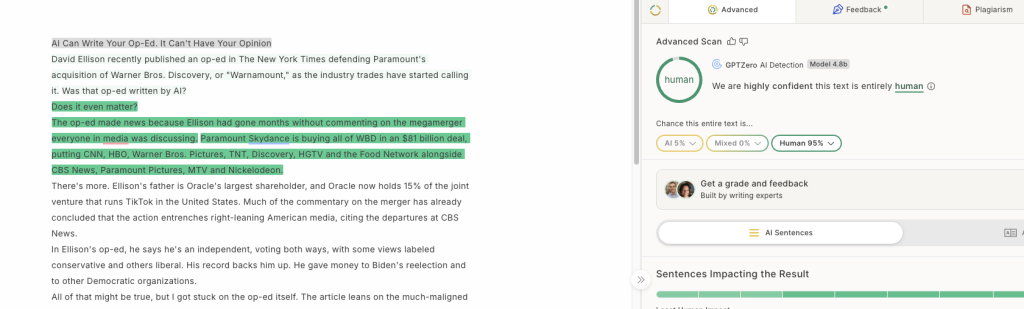
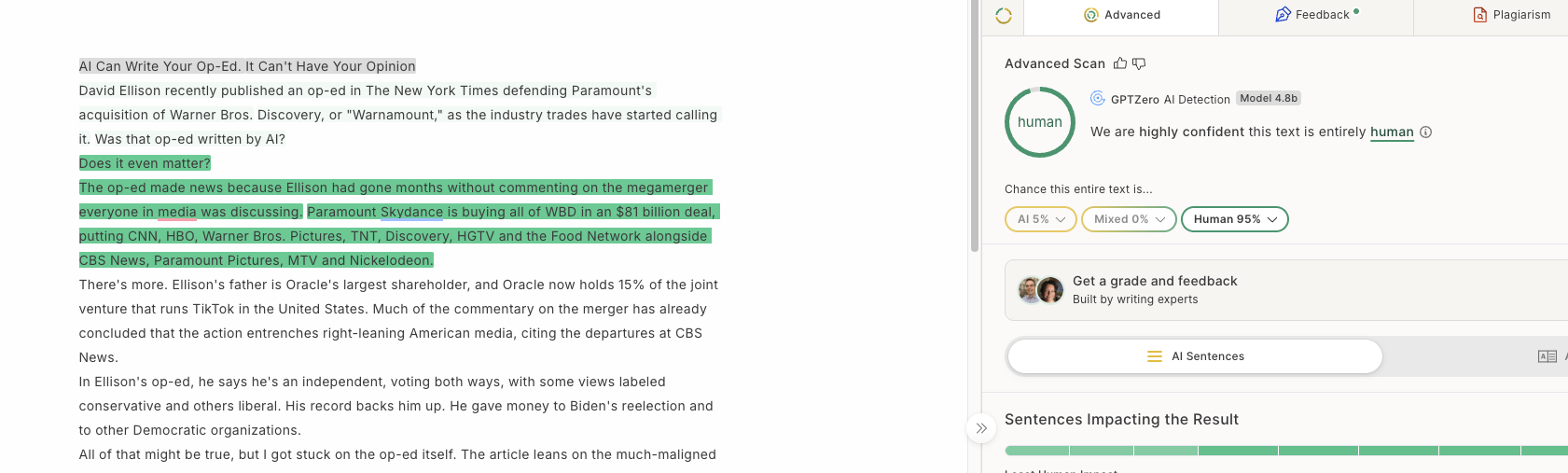
And by the way, GPTZero is “highly confident” that this article was written by a human.