Every year, Black Hat’s opening keynote sets the tone for the industry’s next 12 months.
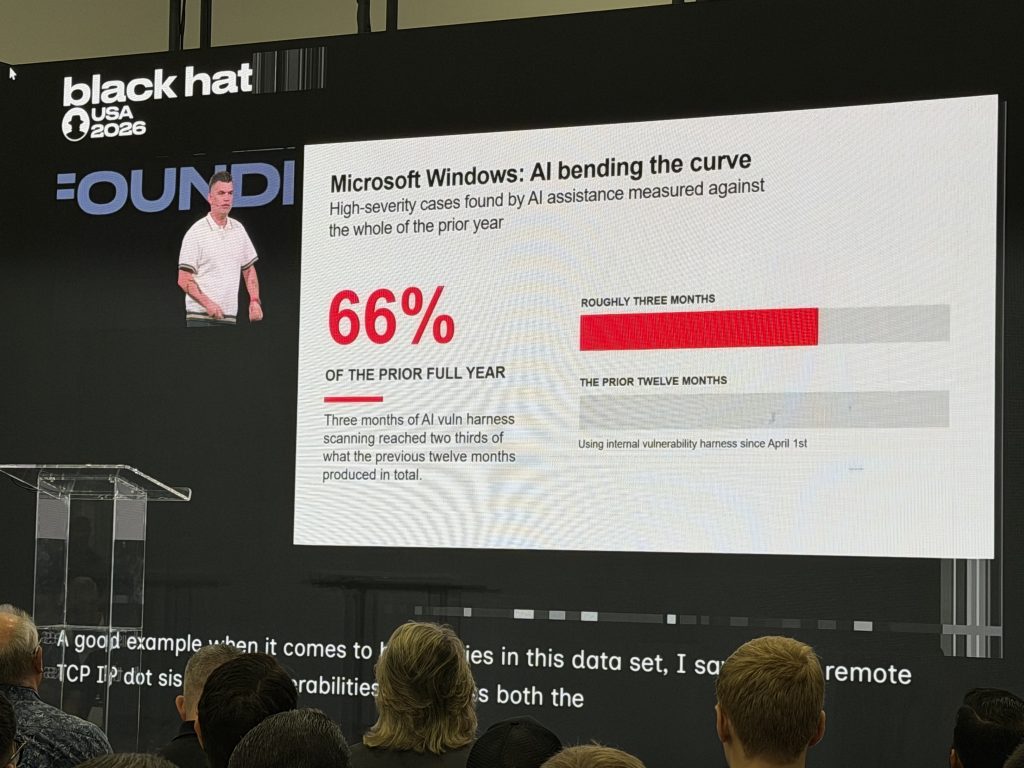
This year it came from David Weston, Microsoft’s agentic security leader, with a talk titled “The End of Rare: Defending When Offense Is Cheap.” His argument: The entire foundation of cybersecurity, the assumption that finding and weaponizing a vulnerability is rare and expensive, is breaking down under AI. Vulnerability-finding agents have pushed discovery costs to record lows, and agents that productize those bugs are doing the same to exploitation. When both drop to costs not seen since the ’90s, the two dominant defensive strategies of the last decade, wait-and-patch-fast and detect-and-respond, stop holding.
That’s a security story. But there’s a comms story inside it too that’s worth paying attention to.
Your AI messaging is now a political signal
Before Weston took the stage, Black Hat’s own leadership flagged something PR people should sit with: Every time a frontier model breaks out and causes chaos, the vendor’s own marketing tends to lean into it, almost as a badge of capability. That bravado isn’t landing as clever positioning anymore. It’s being read on Capitol Hill as evidence of the need for regulation.
That’s the situation for anyone writing AI messaging now. Language that sounds like confident differentiation inside a product marketing deck, phrases like “our model is so capable it did something we didn’t expect,” reads completely differently to a regulator, a reporter working an AI-safety beat or an enterprise cybersecurity buyer doing procurement due diligence.
Be aware that the room you’re messaging to is no longer just your customer. It’s also policymakers and journalists looking for proof points to justify their next move.
The practical takeaway: Give your AI capability claims the same scrutiny you’d give a crisis statement before it goes out. If a stat or anecdote could be read as “our system did something alarming, and we’re proud of it,” it needs a second pass.
Stop choosing between doom and hype. Show the plan instead.
Weston’s keynote had a deliberate arc. First, an unflinching case for why defenders are currently losing ground: Microsoft’s own vulnerability counts have been doubling roughly every six weeks, and AI-generated exploits are moving from research curiosity to near-commodity. Then a hard pivot: Here’s exactly how defenders turn this around. Memory-safe languages that make whole vulnerability classes unshippable, formal verification that lets AI scale proof-writing for security-critical code like cryptography, and automated patching that shortens the gap between disclosure and fix on codebases too large to remediate by hand. He was clear that detection also has to be rebuilt, since it can no longer rely on adversary tooling holding still long enough to become a stable signal.
That structure is a model for how AI security companies, and most AI companies generally, should be telling their story right now. The two failure modes we see constantly are the same two failure modes Weston was arguing against: Either downplay the risk and sound naive, or lean into apocalyptic framing because fear gets clicks and conference buzz. Neither builds lasting trust with a security-literate audience that’s watching this space closely.
The credible middle path is Weston’s path: Name the risk with specific numbers, then show the concrete, technical, unglamorous work being done about it. That’s harder than either the hype version or the doom version. It’s also the only version that holds up six months later when someone checks whether the claims aged well.
The room still matters more than the model
The keynote’s opening moment was about community: Attendance at the conferences is climbing because people need to physically find each other and compare notes when things are moving fast and uncertain, and you can’t inject a fake personality into a room full of your peers.
That’s easy to treat as a throwaway applause line. It shouldn’t be.
As AI-generated content, synthetic personas and autonomous agents get cheaper to produce, the value of verified, in-person, human expertise keeps climbing. For comms and public relations, that’s now a requirement. Executive visibility at events like Black Hat, analyst and reporter relationships built over time, spokespeople who can field a hard technical question live and unscripted. These become more valuable precisely because they’re the things AI can’t fake.
In a year where every vendor will be tempted to lead with an AI-generated stat or an automated thought-leadership post, the different move is putting an actual human in front of actual people and letting them be questioned.
Three takeaways
None of this requires anyone in comms to understand memory-safe programming languages or exploit harnesses. It comes down to three habits:
- Read AI capability claims the way a regulator or reporter would before you publish them.
- Tell the AI security story as risk plus plan, never risk alone or reassurance alone.
- Keep investing in the parts of this industry that still run on human trust, because that’s the one thing this wave of AI cannot replicate.