When I was still knee-deep in the daily journalism grind, I had the occasional surprise and delight experience. One that sticks with me today is Business Insider’s headlines.
Understand that I cut my teeth in the profession at a time when you were told to deliver a powerful, pull-no-punches headline. And here was Business Insider, structuring their headers like eye-catching, two-sentence combinations of cause-and-effect statements, the latter of which sometimes read like SNL punchlines.
They still do.
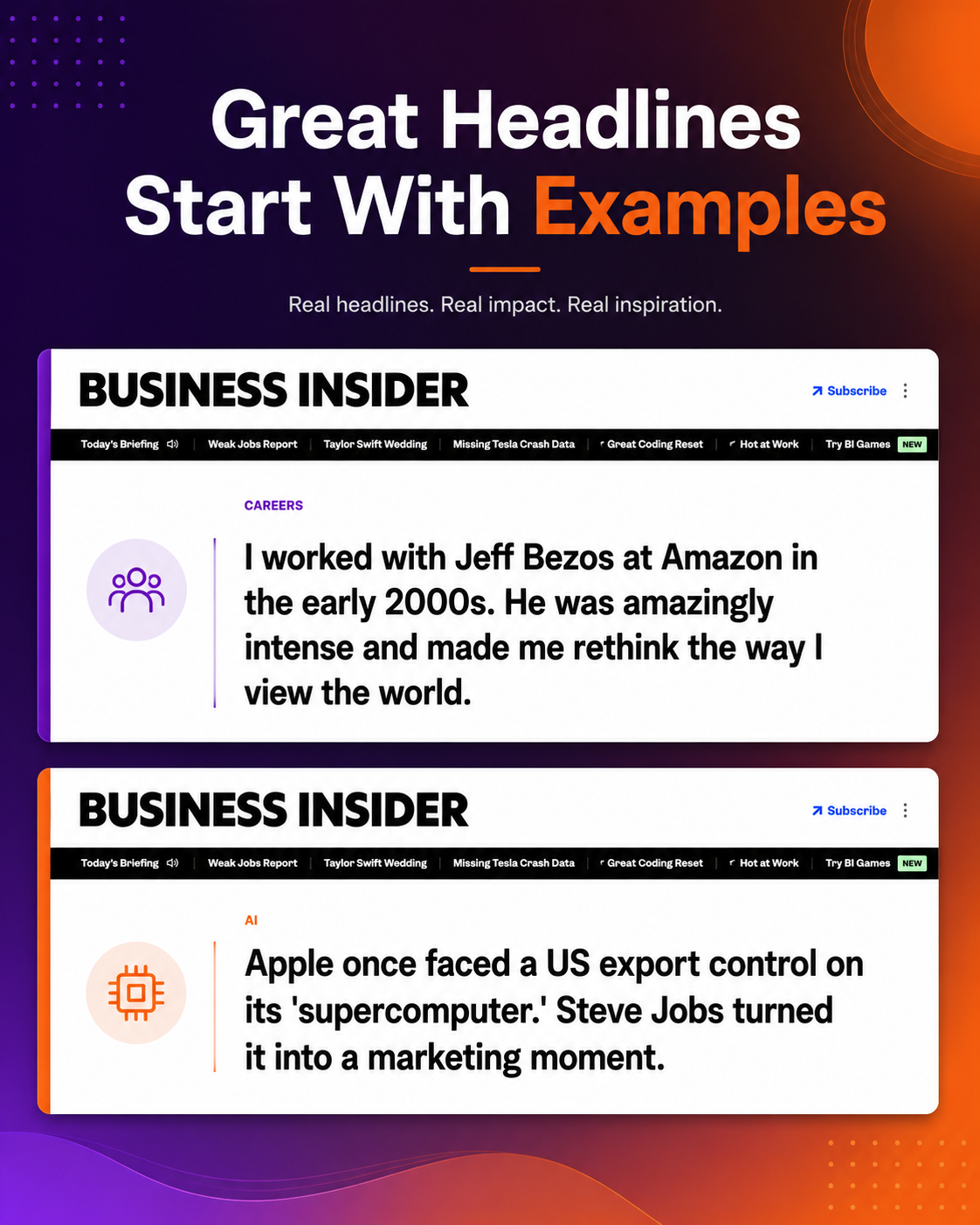
Witness the recent BI headline: “I worked with Jeff Bezos at Amazon in the early 2000s. He was amazingly intense and made me rethink the way I view the world.”
BI had me at the “I worked with Jeff Bezos” declaration. The second sentence describing how Bezos impacted the author is the punchline.
There is also this: “Apple once faced a US export control on its ‘supercomputer.’ Steve Jobs turned it into a marketing moment.”
Of course, not all of BI’s headlines are like that. There is also standard, just-the-facts fare such as, “Trump officials meet with Anthropic to discuss a truce.”
Does headline format affect AI search performance? Yes!
Make no mistake, these headlines aren’t for everyone. But color me a fan. To be sure, BI didn’t corner the market on the style, as BuzzFeed leaned heavily on these, too.
But they absolutely paced the pack in a bumper crop of cause-and-effect headers, some glib, some just illuminating. As much as I tried to follow suit, I was thwarted at media stop after stop by editors saying “We don’t do those kinds of headlines here,” and grumbling something or other about how they were gimmicks.
I would argue that such headlines were good for content distribution by pulling people’s emotional triggers. Editors didn’t care; they lived by the idea that brevity is the sole of wit.
As I transitioned to content marketing in later years, I would ghostwrite for BI and have my field day with that headline structure for bylines. Was I late to the party? Sure, but I still filled a few cups from the keg.
Today, things are changing with regard to content structure for AI citation, including headline optimization for AI search. AI is rapidly disrupting industries, and the SEO to GEO transition is gradually growing legs, prompting publications to adjust their media content strategy for AI.
I’ve poked around a bit and, from what I can tell, BI’s one-two headline punch will still play, albeit the tone should veer from clickbaity to authoritative, or sage.
The specificity-first headline convention aligns decently with how AI systems retrieve and surface content. And we all know by now that structuring media content for LLM retrieval is critical.
When someone asks an AI assistant “how does a 40-year-old engineer negotiate salary,” front-loading concrete details that give the AI clear signals about what the piece contains, they are hitting on one of the critical GEO triggers. Numbers, named protagonists and explicit “how” framing all help AI systems match content to intent.
That’s good editorial content structure for GEO citations.
Meanwhile, the as-told-to format has a hidden AEO advantage: First-person accounts with specific credentials and outcomes tend to get cited as examples rather than just referenced as general information. AI assistants love a concrete illustrative case. Reddit rates as Exhibit A.
Separating the BS from the BI
There is a flipside to this calculus that uncovers friction in the AI content process.
Because BI’s SEO architecture is built around curiosity gaps and traffic volume, the resolution behind a click model can break down because the AI may extract and synthesize the key information – no click required. In short, the more your headline/structure is designed to withhold the answer until after the click, the worse you perform in GEO.
Ultimately, the two-sentence structure can still work, but writers and editors should evolve beyond the personality-driven content (“I did X and saved Y dollars — here’s how”) to more definitional and explanatory content, structured as “What is X,” or “How does X work?”, where X is something like “agentic architecture” or “tokenmaxxing.”
Such structure gives a user a clean, citable answer. It’s also, perhaps not coincidentally, the same recipe some of the media outlets I worked for resorted to to boost traffic.
We called this “service” or “explanatory” journalism, where we developed foundational content designed to rank high in Google and other algorithm-fueled platforms. Today it’s worth exploring explanatory journalism for generative engine optimization.
My advice?
If you’re placing a piece in BI with downstream GEO goals in mind, think about the article body as doing a lot of the structural work that the headline doesn’t; short, quotable declarative sentences early in the piece, a named framework or concept and a clear “the answer is X” moment rather than building to a conclusion.
If the BI headline gets you the human traffic, the internal structure delivers the AI citation. The two can coexist in the same piece so long as you’re intentional about it.
As a reader, I still want my two-sentence headlines. But as a writer, I fully recognize the need to ensure that they deliver value in a way today’s LLM-fueled environments not only value but prize over other content approaches.
Attention may have been all humans needed to get started once upon a time. Today, humans need to account for what algorithms seek to surface. Same as it ever was, but a tad different.