One of the most consequential legal battles in tech history kicked off today in Oakland.
The trial between Elon Musk and Sam Altman has serious implications for OpenAI’s IPO, future governance of AI companies, and the credibility of every founder who ever pitched “mission over profit.”
So I ran an experiment.
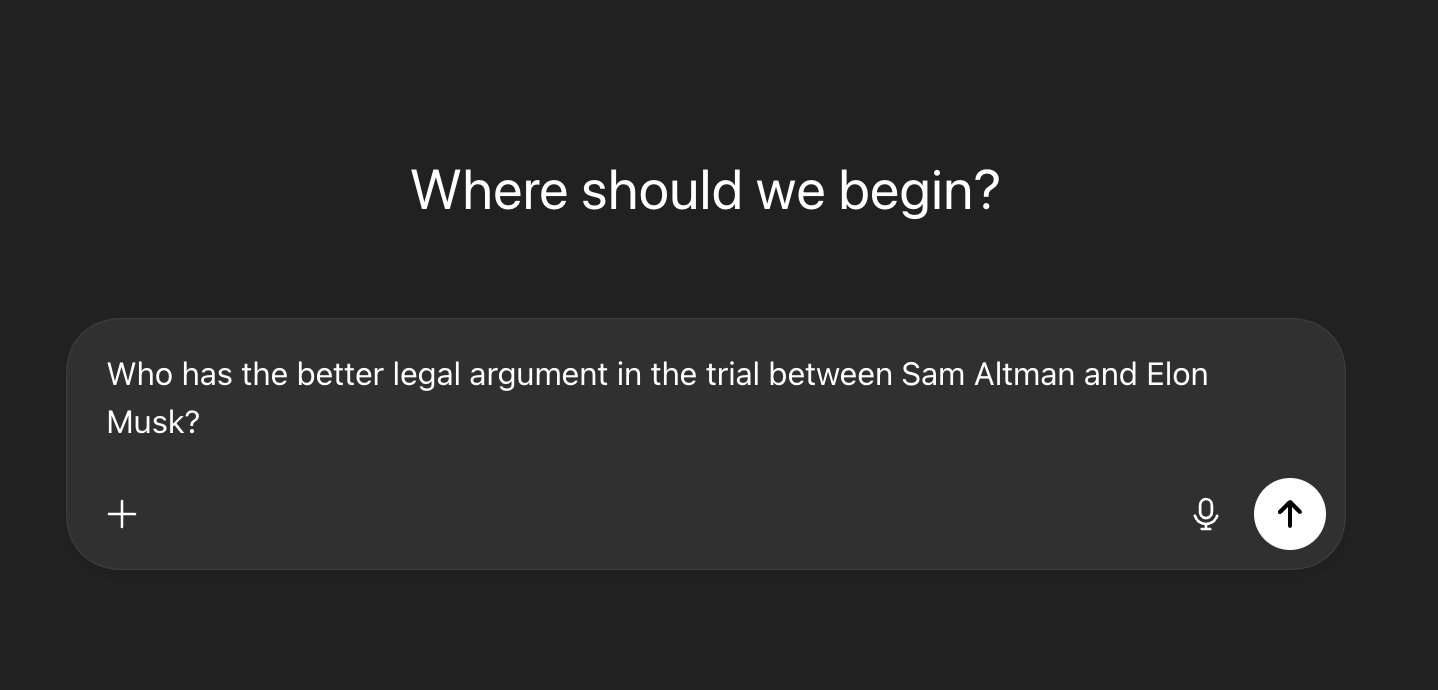
I asked ChatGPT, Claude and Grok the same question: Who has the better legal argument?
The answers were instructive. Not just about the case, but about the tools themselves.
ChatGPT: Polished but stale
ChatGPT delivered a well-organized, readable answer.
It laid out Musk’s fraud claims, noted OpenAI’s corporate structure defense, cited prediction markets, and concluded that Altman and OpenAI likely hold the stronger legal position.
The problem: ChatGPT built a significant portion of its analysis around Musk’s fraud and constructive fraud claims. The reality: Those claims no longer exist.
Musk’s legal team dropped them before the trial to streamline the case. Of 26 original claims, only two remain heading into the courtroom: unjust enrichment and breach of charitable trust.
That’s not a minor detail. It’s load-bearing information that changes the entire legal calculus.
A reader relying on ChatGPT’s answer would walk away thinking Musk still has a fraud case.
He doesn’t.
Claude: Current and more precise
Claude caught the fraud claim dismissal and centered its analysis on the two surviving claims.
It also raised a nuanced point worth noting for anyone tracking this case: Musk is asking that any damages go back to OpenAI’s nonprofit rather than to himself. That posture complicates his standing as an injured party, even if his narrative about betrayal resonates emotionally.
Claude concluded, as ChatGPT did, that Altman and OpenAI hold the stronger legal position. But it got there with more current facts and drew a cleaner line between narrative strength and legal strength.
One small flag: Claude’s response ended with a note about why this matters for AI communications work. That personalization was contextually appropriate but slightly broke the register of what was otherwise a clean legal analysis.
Grok: Surprisingly honest, notably thorough
This is where the experiment gets interesting.
Grok is owned by Musk, so I was asking a Musk-owned platform to assess a Musk lawsuit.
Yet this AI tool also concluded that Altman and OpenAI have the stronger legal position.
In fact, Grok’s analysis was arguably the most comprehensive of the three.
- It raised points the others missed: that Musk himself had proposed for-profit structures tied to Tesla during OpenAI’s early days
- That charitable trust claims often require attorney general involvement rather than individual plaintiffs, and
- That Musk has in some ways “already won” by forcing transparency and using the litigation to advance his own competitive narrative through xAI
That last observation is genuinely useful for communications professionals. Legal outcomes and PR outcomes are not the same thing, and Grok was the only platform that said so clearly.
What this means for PR and marketing professionals
Three key takeaways from this exercise may be worth carrying into your own AI workflows.
- Currency matters more than fluency. ChatGPT’s answer read beautifully, but was based on outdated facts. Before you use AI-generated analysis in a client brief, a pitch or a public statement, verify that the underlying facts reflect the current state of play.
- Conflict of interest doesn’t always produce bias. Grok had every incentive to favor Musk, yet it didn’t. That’s either a sign of good model design or a reflection of how legally weak Musk’s remaining case actually is. Either way, it’s worth noting that platform ownership and model output are not always the same thing.
- The best question isn’t always who wins. All three platforms gave some version of “OpenAI probably has the stronger legal position.” The more useful question for communicators is the one Grok raised: Who is winning the narrative, and are those two things the same? In Musk v. Altman, the answer to both questions may be different, and that gap is where the real story lives.
Both Musk and Altman are expected to testify in the trial, which is scheduled to run four weeks.
Whatever the verdict, the internal documents, diary entries and executive communications that surface in the trial will shape how the public understands AI’s founding mythology for years.
That’s a story worth watching closely, regardless of which AI you use to follow it.