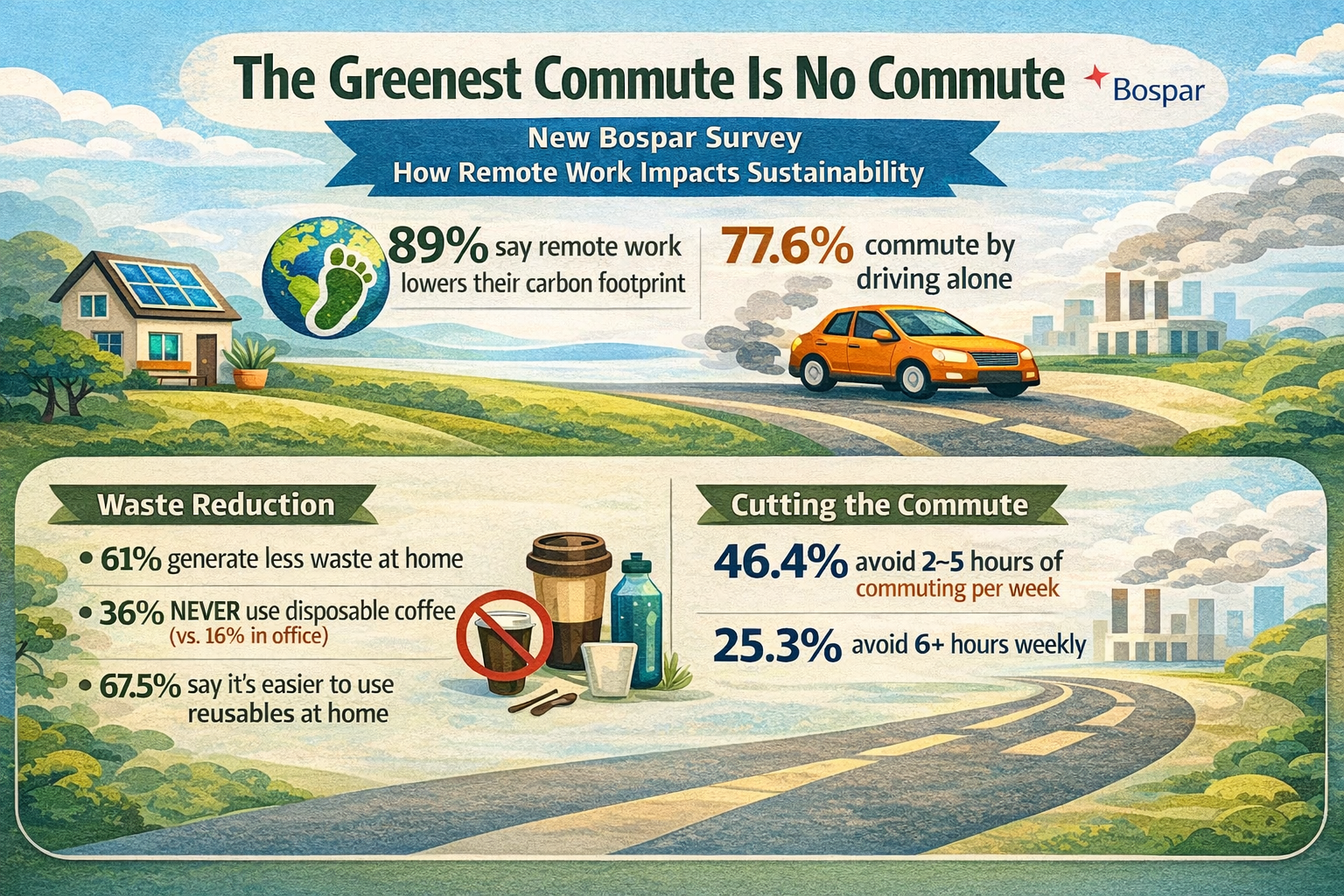
As gas prices soar, nearly 90% say remote work lowers their carbon footprint
SAN FRANCISCO – Apr. 10, 2026 – Remote and hybrid work may be one of the most overlooked climate solutions today. Not because of new technology or regulation, but because it changes everyday behavior at scale.
A new Earth Day survey commissioned by Bospar, the “politely pushy” PR and marketing firm that has operated as a fully remote company since its founding in 2015, and conducted by Propeller Insights in March 2026, reveals that working from home is driving measurable reductions in waste, commuting emissions and resource consumption, while reinforcing broader sustainable habits.
It’s also an antidote to skyrocketing gas prices.
The findings point to what Bospar calls an “invisible sustainability dividend,” one that operates through daily choices rather than infrastructure investments.
Waste drops as daily habits shift
More than six in 10 workers (61.1%) say they generate less waste when working from home, compared to just 10.1% who report generating more.
That shift is driven by a sharp reduction in disposable use:
- 36.1% say they never use disposable coffee cups at home, compared to 16.1% in the office
- Frequent disposable utensil use drops from 30.8% in-office to just 10.1% at home
- 67.5% say it’s easier to use reusable items when working remotely
These small, repeated behaviors make a big difference.
“Earth Day conversations tend to focus on large-scale solutions like infrastructure or policy,” said Curtis Sparrer, principal of Bospar. “But what this data shows is that millions of daily micro-decisions, like skipping a disposable cup or utensil, can drive meaningful impact at scale.”
The commute remains the biggest climate lever
While corporate sustainability efforts often focus on energy or supply chains, commuting is an immediate emissions driver that remote work directly reduces.
- 77.6% of workers commute by driving alone
- Only 1.0% use active transportation like walking or biking
- 65%+ commute at least three days per week
Remote work significantly offsets that emission load:
- 46.4% avoid 2–5 hours of commuting per week
- 25.3% avoid more than six hours weekly
- Nearly 90% believe remote work reduces their carbon footprint, with 52.7% saying significantly
“Companies talk a lot about sustainability goals, but commuting is one of the largest and most overlooked sources of emissions,” Sparrer added. “If most workers are still driving alone, reducing the need to commute may be one of the fastest ways to cut carbon emissions.”
Remote work reinforces sustainable behavior
The impact goes beyond emissions reduction. Working from home appears to actively shape more sustainable lifestyles:
- 71% say they often or always engage in eco-friendly behaviors while working remotely
- 78.2% report making lifestyle changes since commuting less
This suggests a compounding effect: fewer commutes lead to more control over time and daily routines, which in turn encourages more sustainable choices.
Employees question sustainability claims tied to return-to-office policies
The data also highlights growing tension between corporate sustainability messaging and workplace expectations:
- 64.3% have seen companies promote sustainability while requiring commutes
- 72.2% believe companies should report the carbon impact of commuting policies
- 81.1% support tax incentives for fully remote companies
“Employees are starting to connect the dots,” Sparrer said. “You can’t claim to be sustainable while requiring thousands of people to drive to an office every day. That disconnect is becoming harder to ignore.”
Overall, the findings suggest that remote and hybrid work are behavioral climate solutions operating at scale, reshaping how people live, consume and move through their day. “The data highlights an exciting opportunity for companies to expand how they think about sustainability. Workplace flexibility isn’t typically framed as a climate solution, but this research suggests it can be,” said Gabrielle Ayala, Principal at Propeller Insights. “It also raises important questions about how in-office expectations fit into that equation and how companies can build more complete sustainability strategies.”
About Propeller Insights
A national online survey of 1,000 U.S. office workers was conducted by Propeller Insights in March 2026. Respondents opted into an online database; from there, they were targeted based on demographics. To further confirm qualifications, respondents were asked to verify their information in the survey itself, self-identifying qualifications, with the maximum margin of sampling error was +/- 3 percentage points with a 95% level of confidence.