One of the most interesting undercurrents at NAB: Local broadcast is about to level up.
For years, local stations lagged behind national networks in production quality, data usage and storytelling tools.
That’s changing, fast.
The same technologies showcased at NAB are now accessible to smaller teams, which means:
- Small newsrooms can produce significantly more content
- Data-driven storytelling is becoming local
- Production quality is rising across the board
We’re talking about going from 10 stories per month to 200+ pieces of content.
Local outlets aren’t just catching up; they’re becoming more competitive. And that has ripple effects. National broadcasters will need to differentiate more as local media becomes a more powerful channel.
It will also impact public relations.
News Directors: On a Mission
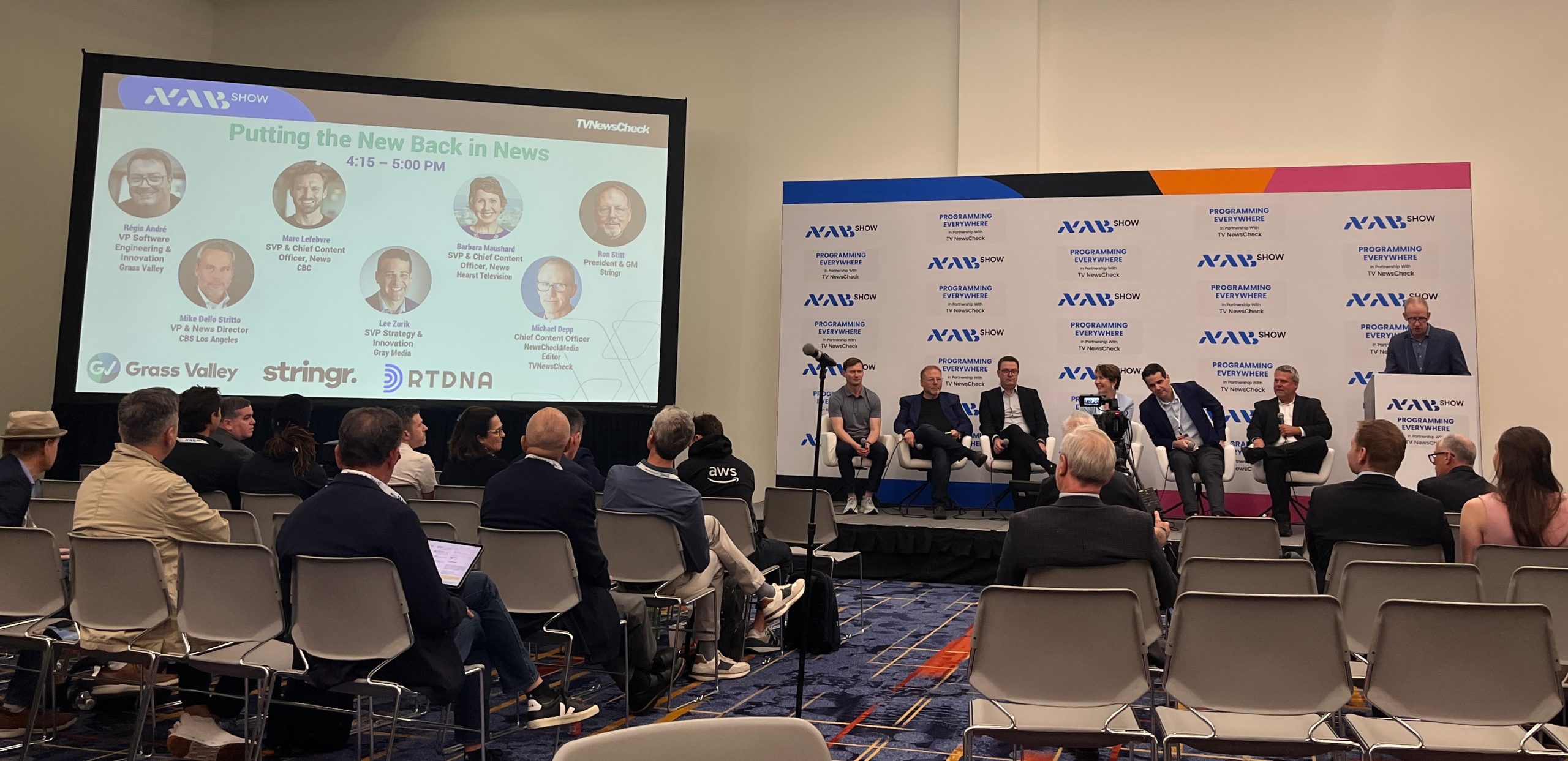
At an NAB panel session, Putting the New Back in News, Mike Dello Stritto, VP and news director at CBS News and Stations in Los Angeles, stressed the importance of connection.
Telling great stories and keeping audiences informed aren’t enough anymore. Local news is about making a lot out of a little, being nimble and creative and ready to stack coverage wins when big moments hit, all while sustaining revenue.
Panelists were blunt: Traditional local broadcast pathways are dying. To attract a younger, more tech-savvy audience with little patience for legacy formats, innovating is essential.
Dello Stritto and the other panelists noted that this shift is forcing news leaders to rethink everything, from how teams work to how quickly they move and how content gets built.
He was at NAB digging into better workflows, faster research processes and tools that streamline daily content development production.
PR is facing the same reality: Traditional storytelling formats are losing resonance with younger audiences.
Smaller Markets Finally Get Their Moment
Local news has always been tough to scale. Audiences are fragmented, news comes from many different directions and the evening broadcast isn’t the household staple it once was. They have to “make do” with legacy equipment and skeleton crews while covering massive ground.
Meanwhile, larger national outlets are outfitted with deeper resources, including larger staffs, stronger infrastructure and more robust talent pipelines.
NAB 2026 highlighted a shift in that dynamic.
Technology is finally trickling down to local newscasts in a meaningful way. Tools built to simplify and streamline are now accessible to lean operations. Workflows that once required rooms full of servers are moving to the cloud and actually working for small teams.
Community papers and small-market stations can implement platforms and tools that produce content at a pace that rivals the big players.
Data Researchers Are Moving Into the Newsroom
Another shift: Data is becoming local.
Smaller market stations are no longer relying solely on national desks for research. They’re hiring their own data researchers and local analysts.
Streamlined content development and workflow offerings are enabling massive data lifts to be performed in-house on a single laptop and at a fraction of the time and bandwidth.
This is a significant shift. Syndicated research only goes so far when you’re trying to make stories resonate regionally. Localized data changes the storytelling itself.
Instead of forcing a national trend into a local angle, stories can originate locally. Instead of a soundbite from a city official, producers can show exactly how a policy impacts specific neighborhoods. Instead of amateur graphics, high-quality visual assets, such as interactive maps, can be used to enhance the local angle.
It shifts the conversation from “here’s what happened” to “here’s what it means for you.”
That distinction matters in a world where audiences get raw headlines instantly on their phones.
Viewers Are No Longer Passive
The relationship between viewers and local news has changed.
Audiences are no longer passive or accept information at face value. They fact-check in real time, share clips instantly and shape the conversation as it unfolds.
Local news that ignores the voice of its viewers is out of step.
The tools at NAB pointed to a new broadcast model, in which local stations can operate more like the behemoths. Micro-sites, interactive maps, embeddable graphics, multimedia and data dashboards can be part of their reporting.
The story no longer ends when the broadcast does. It continues in places where viewers can interact with it.
That requires faster workflows—but also a mindset shift.
One standout example: KCBS/KCAL in Los Angeles and its “The Desk” concept, an interactive, viewer-first approach that extends beyond traditional formats.
It’s built around viewer participation and editorial transparency that let the audience engage with the content, provide live feedback, text with assignment editors and develop relationships with reporters.
At NAB, this was acknowledged as essential in an era of declining trust in media.
When done right, it’s a real differentiator. And local stations are uniquely positioned to make it work.
The Death of the Green Screen (Kind Of)
The traditional green screen is effectively obsolete. The static weather wall is being replaced by fully dynamic environments where the entire studio becomes the canvas.
Producers can now build visual worlds around anchors that change from segment to segment, story to story and are based entirely on ways that serve the moment.
It may seem small, but it represents a bigger trend: Everything is on the table.
For stations willing to reimagine their approach, the creative ceiling is disappearing.
The Window Is Open—But Not Forever
Local news is at a crossroads.
News operations that combine data-driven storytelling, streamlined workflows and real community engagement will build audience loyalty that’s hard to replicate later.
Those that wait for the “right moment” to modernize will find the gap widening.
At NAB, the news directors exploring beyond the obvious understood this.
This isn’t about chasing shiny tools. It’s about connection—building something meaningful even as newsroom resources shrink.
The tools are here. The audience is ready.
The question NAB left hanging: Who moves first?